
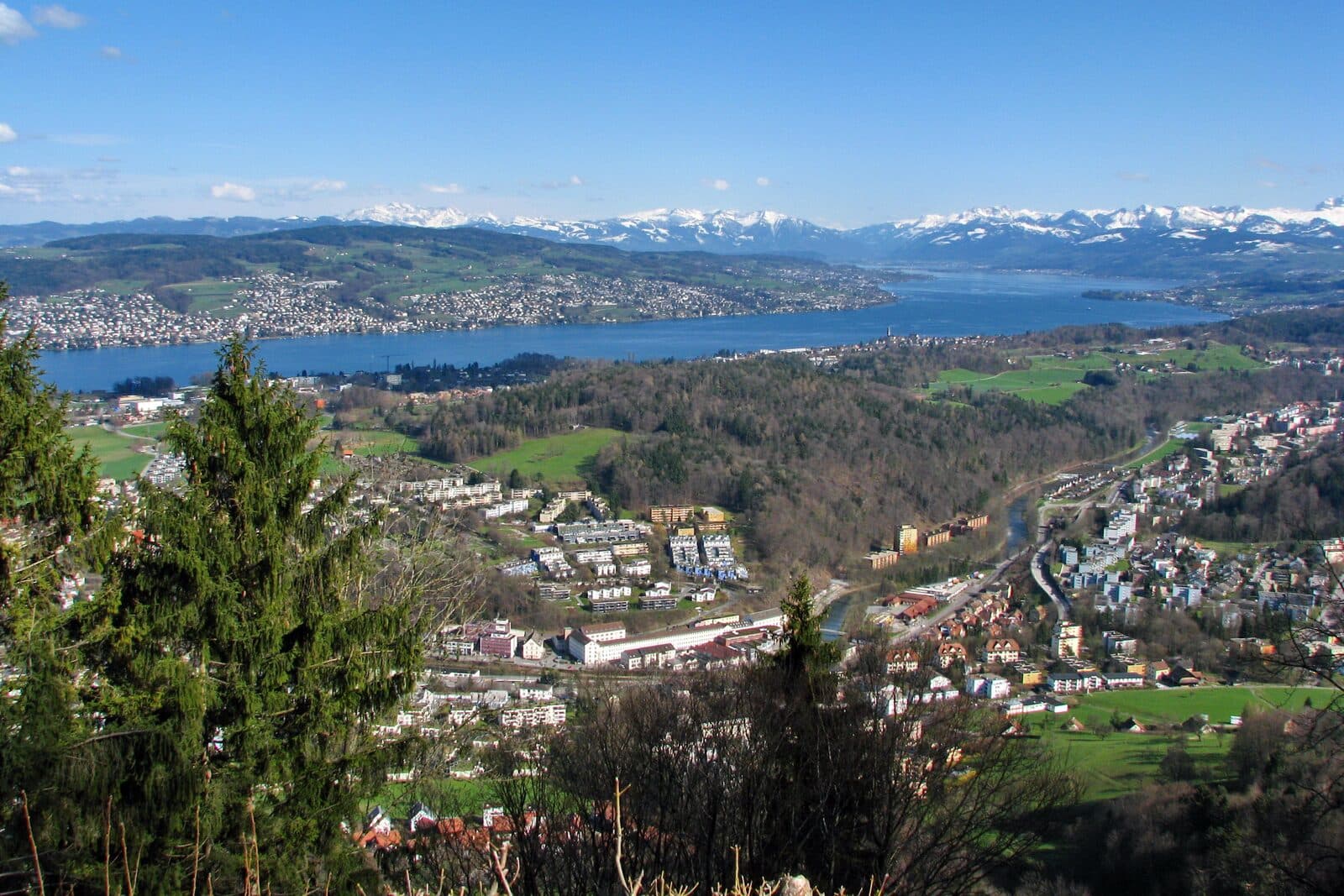
1. Overview — the Canton of Zurich in the migration-law context

The Canton of Zurich is the most populous canton in Switzerland. At the same time it hosts the numerically largest migrant population in the country: around one quarter of the resident population holds a foreign nationality. In terms of the relative share of foreign nationals, Zurich ranks, in an intercantonal comparison, behind cantons such as Geneva and Basel-City; in absolute figures, however, the canton clearly takes first place and thus has the largest single non-Swiss resident population in the Confederation. The exact, annually updated population and foreign-national figures are available from the Federal Statistical Office (bfs.admin.ch) as well as from the Statistical Office of the Canton of Zurich (statistik.zh.ch); they are subject to annual fluctuations and are deliberately not reproduced here as a fixed figure.

The Zurich migration structure differs structurally from that of Geneva: whereas Geneva is shaped by the international organisations (IO) sector and the carte de légitimation, the Zurich constellation is dominated by the Zurich financial centre, the research and education cluster (ETH, University of Zurich, University Hospital), the density of global headquarters (Google Switzerland, UBS — successor to Credit Suisse, IBM Research, Disney, Microsoft, as well as numerous pharmaceutical and technology companies) and a broad services and industrial base. The migration-law picture, in terms of both volume and complexity, is accordingly weighted differently from Geneva.

The competent cantonal authority for all residence-law procedures is the Migrationsamt des Kantons Zürich (Migration Office of the Canton of Zurich).

Migrationsamt des Kantons Zürich The currently valid postal address, the telephone numbers, the email addresses of the individual specialist units, the counter opening hours as well as the online services can be obtained exclusively from the official authority page zh.ch/migrationsamt. The contact details of cantonal offices change; the official publication of the Canton of Zurich is always authoritative, not a third-party reproduction.

1.1 Zurich migrant population — structural approximation

The presentation below outlines the structure of the Zurich migrant population qualitatively; it is not a statistic. The exact, annually updated permit figures are to be obtained from the Federal Statistical Office (bfs.admin.ch) and the Statistical Office of the Canton of Zurich (statistik.zh.ch).

  • EU/EFTA nationals: typically constitute the numerically largest group, notably from Germany, Italy, Portugal, Spain, France, Poland and Croatia.
  • Third-country nationals: notable communities from, among others, Turkey, Sri Lanka, Kosovo, North Macedonia, China and India, as well as from the asylum countries of origin of the respective current constellation (Eritrea, Afghanistan, Syria, Ukraine — cf. the continuously updated asylum statistics of the SEM).
  • B residence permits: as a rule the most frequent permit category.
  • C settlement permits: regularly the second most frequent category; notably among EU/EFTA and third-country nationals resident in Zurich for many years with successful integration.
  • L short-term permits: frequent in the case of time-limited gainful employment in the finance, research and technology sectors.
  • G cross-border permits: owing to the distance from the national border, less significant than in Geneva, Basel or Ticino, yet certainly present in the canton's border-near north (Kloten/Bülach region facing southern Germany).
  • F and N permits: asylum-procedure constellations; as a heavily populated canton, Zurich is one of the largest reception cantons in the SEM's distribution key (Art. 27 AsylA, Asylum Act, SR 142.31).

2.1 Applicable federal law

In migration law, the Canton of Zurich applies — like all cantons — primarily federal law: the Federal Act on Foreign Nationals and Integration (FNIA, SR 142.20), the Ordinance on Admission, Residence and Gainful Employment (OASA, SR 142.201), the Agreement on the Free Movement of Persons (AFMP, SR 0.142.112.681) with its associated ordinances, the Asylum Act (AsylA, SR 142.31) as well as the relevant SEM practice and directives. For the legal bases, see the glossaries on AIG/VZAE, FZA and AsylG.

2.2 Cantonal implementing law

At the cantonal level, the following are in particular relevant:

  • Zurich implementing law on the FNIA (cantonal introductory and implementing provisions on the Federal Act on Foreign Nationals and Integration). The formal designation and the cantonal LS numbering are to be obtained from the current state of the Zurich collection of laws (zhlex.zh.ch).
  • Cantonal citizenship law of the Canton of Zurich: cantonal concretisation of the naturalisation procedure supplementing the Swiss Citizenship Act (SCA, SR 141.0) and the Citizenship Ordinance (CO, SR 141.01); see section 9.
  • Lawyers Act of the Canton of Zurich (AnwG, LS 215.1): governs the legal profession in the Canton of Zurich, notably admission to the cantonal bar register and the activity of the supervisory commission, concretising the Federal Act on the Free Movement of Lawyers (LLCA, SR 935.61).
  • Administrative Justice Act of the Canton of Zurich (VRG): cantonal procedural law for proceedings before the cantonal administrative authorities and the Administrative Court. The current version and the cantonal LS numbering are available via zhlex.zh.ch.

A consolidated overview of the cantonal enactments with a migration nexus is found in the Index of Cantonal Enactments.

3. Structure of the Zurich Migration Office

The Migration Office of the Canton of Zurich (MA ZH) is organised as an office of the Security Directorate (Sicherheitsdirektion) and is subdivided by specialist units. The presentation of the structure below is to be understood as a rough orientation; the exact, currently applicable organisation is to be obtained from the official authority page (zh.ch/migrationsamt).

3.1 General unit — residence permits

This unit handles the ordinary foreign-national-law procedures of the permanent resident population:

  • B EU/EFTA: residence permits for nationals of EU/EFTA states under the AFMP.
  • B third-country: residence permits for third-country nationals under the FNIA (family reunification, gainful employment under Art. 18 FNIA et seq., education and continuing education under Art. 27 FNIA, etc.).
  • Extensions and changes of status.

3.2 C settlement permit

A separate procedural branch for the granting and renewal of the C settlement permit, including the ordinary granting after ten years (Art. 34 para. 2 FNIA) and the early granting after five years in the case of successful integration (Art. 34 para. 4 FNIA).

3.3 Family reunification

Specialised handling of family-reunification applications under Art. 42 FNIA et seq. (for family members of Swiss nationals and settled persons holding a C permit) as well as Art. 44 FNIA (for family members of B-permit holders). Family reunification with IO personnel arises in the Canton of Zurich markedly less often in practice than in Geneva; insofar as relevant, the Migration Office coordinates with the FDFA Mission in Geneva (for carte-de-légitimation constellations).

3.4 Asylum

Handling of procedures in connection with asylum applications (preparation and enforcement of removal decisions, coordination with the Federal Asylum Centre (FAC) in Zurich and with the SEM, status extensions and changes for N, F, S and B-refugee permits).

3.5 Naturalisation

Handling of cantonal naturalisation applications; coordination with the municipalities of residence and the Confederation (SEM). See section 11.

3.6 Return counselling for the asylum sector

Important delimitation: the return counselling of the Canton of Zurich is an asylum-specific counselling service. It is not to be confused with the return counselling of Basel-City (RBS-Basel), which historically has its own tradition. The Zurich return counselling is available exclusively to persons in the asylum sector: asylum seekers in pending procedures (N permit), provisionally admitted persons (F permit) and persons whose asylum status has expired. It is not available to tourist overstayers, third-country nationals removed under ordinary residence law, or persons with no asylum context.

The currently valid contact details of the Zurich return counselling (telephone, email, opening hours) are available via the official authority page of the Canton of Zurich (zh.ch); they are deliberately not reproduced here as fixed values, since the contact details of cantonal bodies change.

The return counselling advises on voluntary return, organises travel documents and travel modalities and works together with the SEM's return-assistance programmes. The federal-law bases of removal are set out in the AIG/VZAE Glossary.

Note on scope: SwissImmigrationPro provides no strategy for avoiding return counselling or for circumventing removal decisions. Return counselling is an assistance service in the asylum context, not a tool of ordinary migration management.

4. Zurich practice points — what distinguishes the Canton of Zurich in migration law

4.1 Language proof

For the granting of a B permit within family reunification from a third country, the Migration Office requires, in accordance with the federal-law minimum standards, proof of German at level A1 oral in accordance with the Common European Framework of Reference for Languages (CEFR). For the early granting of the C settlement permit after five years (Art. 34 para. 4 FNIA in conjunction with Art. 60a OASA, Ordinance on Admission, Residence and Gainful Employment, SR 142.201), cantonal practice regularly draws on a level of B1 oral and A1 written in German.

The fide certificate in the German language is accepted as officially recognised proof. Alongside this, the diplomas and certificates named in Art. 77d OASA apply, in particular telc, Goethe and ÖSD certificates at the corresponding level. In the Zurich context, the High German (Hochdeutsch) variant of the language proof is authoritative; Swiss German is not examination-relevant. The exact, currently applicable requirements arise from the federal-law specifications and the practice of the Migration Office; cantonal interpretations of the federal-law minimum language standards may vary in individual points and are to be checked via the official authority page (zh.ch/migrationsamt).

4.2 Integration agreement (integration recommendation)

Under Art. 58a FNIA and Art. 58b FNIA, the canton may conclude an integration agreement with third-country nationals who exhibit integration deficits, or issue an integration recommendation. Zurich practice uses these instruments selectively and not systematically — in contrast to the Canton of Vaud, which is known for regularly deploying the convention d'intégration. A Zurich integration agreement typically applies when, upon an extension, deficits are identified in the areas of language, gainful employment or respect for public safety and order.

4.3 Hardship case under Art. 30 para. 1 let. b FNIA

Zurich's hardship-case practice lies, in an intercantonal comparison, in the middle range: more moderate than the Aargau practice regarded as restrictive, yet more reserved than the Geneva practice regarded as accessible. The assessment is carried out under Art. 31 OASA on a case-by-case and discretionary basis using the federal-law criteria: integration (language, work, social inclusion), family circumstances, financial situation, duration of residence, state of health as well as reintegration possibilities in the country of origin. The SEM approval requirement under Art. 99 FNIA is to be observed and may substantially prolong the overall duration of a hardship-case procedure.

Note on scope: SwissImmigrationPro provides no strategic advice for the argumentation of a hardship-case application. The case-dependent presentation of evidence and the interpretation of the indeterminate legal concepts belong to legal practice and are to be handled via the Zurich legal profession (admission to the cantonal bar register; see section 14).

4.4 C settlement permit, early granting

The early granting of the C settlement permit after five years instead of ten (Art. 34 para. 4 FNIA) presupposes successful integration and lies within the discretion of the cantonal authority. There is, to that extent, no legal entitlement to the granting; the authority assesses the fulfilment of the integration criteria on a case-by-case basis. Decisive factors are elevated language skills (in cantonal practice regularly B1 oral and A1 written), economic self-sufficiency without receipt of social assistance, orderly financial circumstances and the absence of relevant criminal-record entries. Reliable cantonal granting rates for the early granting of the C permit are not published regularly by the Migration Office; a quantified success rate can therefore not be given seriously.

4.5 Family reunification — Zurich interpretation

In family reunification from third countries (Art. 43–47 FNIA), the Migration Office examines the cumulative conditions: sufficient income from gainful employment, suitable housing, no dependence on social assistance, language, integration. Zurich applies the federal-law benchmarks. In assessing the size of the housing, Zurich practice tends to draw on the SKOS/CSIAS standards; the market reality of the Zurich housing market — one of the most expensive in Switzerland alongside Geneva, Zug and Basel — is taken into account on a case-by-case basis, without an autonomous cantonal housing table having been published.

For the reunification of children, the differentiated reunification deadlines and the age-dependent conditions under Art. 47 para. 1 FNIA in conjunction with Art. 73 OASA are to be observed; the law distinguishes in particular according to the age of the child to be reunified and ties the start of the deadline to the emergence of the reunification entitlement. In the case of late reunification applications, the Migration Office examines whether "important family reasons" within the meaning of Art. 47 para. 4 FNIA exist. The practice is casuistic; the relevant case law of the Federal Supreme Court on family hardship is authoritative. The concrete interpretation in the individual case is to be reconciled with the respectively current practice and case law.

4.6 Practice in the case of separation and divorce

In the case of separation or divorce from Swiss citizens or C-settled persons, Art. 50 FNIA applies. Zurich practice examines the conditions carefully: a three-year marital union and successful integration (Art. 50 para. 1 let. a FNIA) or important personal reasons (Art. 50 para. 1 let. b FNIA, notably domestic violence). In domestic-violence constellations, coordination with the Zurich victim-support structures (Opferhilfe Zürich; see section 15) as well as with the specialised police unit (Fachstelle Häusliche Gewalt of the Zurich Cantonal Police) is to be observed. For the in-depth presentation, see Separation and Divorce (Art. 50 FNIA).

5. Asylum in Zurich

5.1 Federal Asylum Centre (FAC) Zurich

Zurich is the site of a Federal Asylum Centre (FAC) of the Zurich region, in which phase 1 of the accelerated asylum procedure under Art. 26b AsylA et seq. (Asylum Act, SR 142.31) takes place. Within the FAC the first interview is conducted, the federal legal-representation service is granted, and either a ruling is issued (with a subsequent appeal deadline and any removal) or the procedure is transferred into the extended procedure.

5.2 Extended procedure — cantonal allocation

Where an asylum application is not decided within phase 1 and is transferred into the extended procedure (Art. 26d AsylA), the allocation to a canton is carried out according to the SEM's distribution key. Zurich takes on, in accordance with its population size, a substantial share of the extended procedures. During the extended procedure, the asylum-seeking person lives in the Canton of Zurich, is registered there with the authorities and is subject to the cantonal asylum-coordination structure; the legal-representation service typically passes from the federal legal representation (federal RBS) to a cantonal legal-counselling service.

The contact points active in Zurich, mandated by the SEM under Art. 102f AsylA or recognised as counselling services, comprise:

  • Zürcher Beratungsstelle für Asylsuchende (ZBA) / HEKS — established asylum counselling within the structures of the Swiss Refugee Council network. The currently valid address and the contact details are available via HEKS (heks.ch).
  • Freiplatzaktion Zürich — specialised in constellations following negative asylum decisions and in the transition to a regulated residence perspective.
  • Caritas Zürich — church-funded counselling offering with an asylum focus.
  • Swiss Refugee Council (OSAR/SFH) — nationwide umbrella organisation.

A complete and current list of the mandated legal-counselling services (RBS) is found on the website of the Swiss Refugee Council (osar.ch); this list is authoritative.

5.4 Unaccompanied minor asylum seekers (UMA / MNA)

For unaccompanied minor asylum seekers, the central office for unaccompanied minor asylum seekers (ZS MNA) at the Office for Youth and Career Counselling (AJB) is competent in the Canton of Zurich. This office coordinates the guardianship arrangement (legal representation), schooling and vocational integration as well as the specific socio-pedagogical support. For the in-depth presentation, see the Asylum Law Glossary (AsylA).

For the in-depth presentation of asylum law in general, see the Asylum Law Glossary (AsylA).

6. Procedure duration and Zurich reference values

The procedure durations at the Zurich Migration Office vary considerably depending on the state of the file, the completeness of the documents, the workload of the respective section and the complexity of the case. For a fully documented ordinary permit procedure, a processing time of the order of around two months is to be expected as a rough orientation; complex applications, those subject to approval or incomplete ones take correspondingly longer. Only the official information of the Migration Office (zh.ch/migrationsamt) is authoritative — the values below are non-binding empirical orders of magnitude, not guaranteed deadlines.

ProcedureOrder of magnitude (non-binding)
First B application (family reunification, employment application)several weeks to a few months
B extensiona few weeks
Ordinary C application (after 10 years)several weeks to a few months
Early C application (Art. 34 para. 4 FNIA, after 5 years)several weeks to months
Family reunification (third country)several months
Hardship case Art. 30 para. 1 let. b FNIAtypically many months
Naturalisation application (municipal + cantonal + Confederation)overall procedure regularly over one to several years
Appeal procedure Administrative Court ZHseveral months to over a year

Note: the SEM approval of cantonal preliminary decisions (Art. 99 FNIA) is not included in the orders of magnitude above and may, in approval-subject constellations, take additional weeks to months.

6.1 Factors influencing the procedure duration

Several factors act on the effective procedure duration at the Zurich Migration Office:

  • Completeness of the file: incomplete applications are as a rule answered with a request for additional documents, which costs several weeks between the individual steps.
  • SEM approval requirement: in approval-subject constellations (Art. 85 para. 2 OASA, Art. 86 OASA) the overall duration is prolonged correspondingly.
  • Provision of the language proof: where language certificates are obtained only after the application is filed, the procedure is effectively suspended until they are submitted subsequently.
  • Security and criminal-record clarifications: for persons with stays in several countries or where criminal-record extracts from third countries are required, the duration may be prolonged by months.
  • High workload of the Zurich Migration Office: owing to the high case numbers — Zurich is the largest canton by volume — seasonal peaks may occur, notably after the turn of the year and during the summer months.

6.2 Acceleration possibilities

No formal acceleration is provided for at the Zurich Migration Office. Effective in practice, in well-founded cases, are:

  • Written inquiry on the status of the procedure after the lapse of the respective reference values
  • Indication of particular urgency (e.g. taking up a post with a contractual deadline, enrolment of the children in school, medical treatment)
  • Appeal for denial of justice or for unjustified delay to the Administrative Court of the Canton of Zurich under the VRG, provided a disproportionate delay exists — as a last resort and recommended with legal accompaniment

Note on scope: SIP provides no template for acceleration letters or appeals for unjustified delay. These belong to legal practice.

7. Municipal voting rights in Zurich — the Zurich special case

In contrast to the cantons of Jura, Neuchâtel, Vaud, Fribourg (upon application of the municipality), Geneva and Basel-City (restricted), the Canton of Zurich has no municipal voting and electoral rights for foreign nationals. Even C-permit holders with long-standing residence in Zurich have, at the cantonal and municipal levels, neither active nor passive electoral and voting rights. Voting rights are, in the Canton of Zurich, tied to Swiss citizenship.

Initiatives to introduce municipal voting and electoral rights for foreign nationals have, in the past, been repeatedly raised politically in the Canton of Zurich, but have not been accepted at the ballot box. The respective current political status (pending initiatives, voting results) is available via the State Chancellery of the Canton of Zurich and the business register of the Cantonal Council (Kantonsrat).

This constellation means, in migration counselling, that naturalisation is, for third-country and EU/EFTA nationals resident in Zurich for many years, the only path to a position of political participation rights in Switzerland — which makes the naturalisation application in Zurich practically highly relevant (section 11).

8. Tax status and withholding tax in Zurich

The tax burden is heterogeneous in an intercantonal comparison and moreover varies strongly between the individual Zurich municipalities (differences in the municipal tax multiplier). The migration-law-relevant question is not the level of the tax burden, but the form of taxation during the time-limited residence — notably withholding taxation and the transition to ordinary assessment.

8.1 Withholding tax for B-permit holders

Gainfully employed foreign nationals without a settlement permit (both third-country and EU/EFTA nationals with a B permit) are as a rule subject to withholding tax (tax deduction at source). The withholding tax on income from gainful employment is a cantonal tax; it is deducted directly from the salary by the employer and accounted for via the Cantonal Tax Office. The levy is based on the harmonised withholding-tax law; the cantonal tax act as well as the federal-law harmonisation specifications are authoritative.

Where the annual gross income from gainful employment exceeds the threshold laid down in withholding-tax law (set uniformly across Switzerland at CHF 120,000), a subsequent ordinary assessment (NOV) is carried out ex officio; below this threshold the withholding tax is in principle of definitive effect, whereby an NOV is possible on application. Upon entry into the C settlement permit or upon marriage to a Swiss citizen, the withholding-tax liability ends and ordinary tax assessment takes effect. The concrete tariffs, threshold values and procedural steps are to be obtained from the Cantonal Tax Office of Zurich.

8.2 Practical notes

The Zurich withholding tax is enforced by the Cantonal Tax Office in cooperation with the municipalities. For the migration-law assessment, it is to be noted that tax debts or debt-enforcement proceedings do not directly lead to the refusal or revocation of a permit. Existing indebtedness may, however, indirectly feed into the foreign-national-law integration assessment, for example when, upon an extension, the criterion of participation in economic life or of orderly financial circumstances is examined. The financial situation is thus one element among several in an overall appraisal — and not an autonomous ground for revocation.

Note on scope: SwissImmigrationPro is not tax advice. For concrete questions on withholding tax, on the NOV, on tax-status optimisation or on double-taxation matters, the Cantonal Tax Office of Zurich or qualified tax advice is to be consulted.

9. Naturalisation in Zurich

9.1 Three-tier procedure

Naturalisation in Switzerland follows a three-tier procedure: federal (authorisation of the Confederation under the Swiss Citizenship Act, SCA, SR 141.0, and the associated Citizenship Ordinance, CO, SR 141.01), cantonal (citizenship of the Canton of Zurich under cantonal citizenship law) and municipal (citizenship of the municipality of residence). All three levels must be authorised cumulatively. The Citizenship Act (the act) and the Citizenship Ordinance (the implementing ordinance) are, in this respect, two separate enactments: the substantive basic conditions are in the act, the implementing concretisations — notably as regards the language proof — in the ordinance.

9.2 Federal-law conditions

At the federal level, the conditions of the Swiss Citizenship Act (SCA, SR 141.0, in the version in force since 1 January 2018) and the Citizenship Ordinance (CO, SR 141.01) apply: ten years of residence in Switzerland (Art. 9 SCA) and successful integration (Art. 12 SCA) belong to the act; the language proof — in practice B1 oral and A2 written in a national language (in Zurich: German) — is, by contrast, regulated in the ordinance (Art. 6 SR 141.01, CO). Added to this is the requirement that there be no endangerment of Switzerland's internal or external security. For the in-depth legal presentation, see the Citizenship Law Glossary (SCA/CO).

9.3 Cantonal and municipal conditions

At the cantonal level, the Zurich naturalisation procedure requires, in addition to the federal-law minimum residence, residence in the Canton of Zurich as well as in the respective municipality of residence. The cantonal and municipal residence duration concretely required arises from cantonal citizenship law and the respective municipal regulation and varies from municipality to municipality. The requirements applicable to a particular municipality of residence are to be inquired about at the cantonal municipalities office or at the municipality of residence itself; a blanket number of years would not be reliable in view of municipal autonomy.

9.4 Municipal hearing — heterogeneous and changing practice

In many Zurich municipalities, a municipal hearing (in part by a "naturalisation commission") was part of the procedure. These hearings were politically controversial owing to the heterogeneity of the practice and isolated incidents; subsequently, the standardisation and stronger harmonisation of the municipal naturalisation procedure was advanced, in order to strengthen the equal treatment of applications. Whether and in what form a hearing still takes place in a particular municipality is governed by the respective municipal regulation and is to be clarified with the municipality of residence; municipal practice is not uniform.

9.5 Cantonal knowledge and integration proof

At the cantonal or municipal level, a knowledge proof (on the history, geography and civics of Switzerland and the Canton of Zurich) may be required. Alongside this, the language proof (in practice B1 oral, A2 written, fide or equivalent) and a criminal-record extract are to be provided. The concrete form of the knowledge and integration proof arises from cantonal citizenship law and the municipal regulations and may change; the respectively current cantonal version is authoritative.

For the in-depth legal presentation of the 2018 Citizenship Ordinance, see the Citizenship Law Glossary (SCA/CO).

Note on scope: SwissImmigrationPro provides no instructions for citizenship strategy optimisation. In particular, SIP issues no recommendations as to in which municipality an application would be "easier" — such advice would be a classic example of impermissible canton-shopping.

10. Migration Office — accessibility and online services

All contact details of the Migration Office of the Canton of Zurich — postal address, telephone numbers, email addresses of the individual specialist units, counter opening hours and public-transport accessibility — can be obtained exclusively from the official authority page and are deliberately not reproduced here as fixed values. The contact details of cantonal offices change; a third-party reproduction would quickly become outdated and is not reliable in the YMYL context.

  • Authoritative source: zh.ch/migrationsamt (official authority page of the Migration Office of the Canton of Zurich)

10.1 Online services

The Canton of Zurich offers part of the foreign-national-law procedural steps via digital services. Which steps (e.g. extensions, change of address, certain first applications, appointment reservations, obtaining forms) are available online arises from the current offering on zh.ch/migrationsamt. The scope of the online services is being continuously expanded; the official publication is always authoritative.

11. Supervisory Commission for Lawyers of the Canton of Zurich

The Supervisory Commission for Lawyers of the Canton of Zurich supervises the lawyers entered in the Zurich bar register. It is competent on the basis of the Lawyers Act of the Canton of Zurich (AnwG, LS 215.1) and the Federal Act on the Free Movement of Lawyers (LLCA, SR 935.61).

The currently valid address and the contact details of the supervisory commission are available via the official publication of the Canton of Zurich (zhlex.zh.ch or the page of the courts and judicial authorities of the Canton of Zurich) and are not reproduced here as fixed values.

Note: SwissImmigrationPro is not a law firm and replaces no legal advice. The supervisory commission is not a counselling service for clients, but a professional-law supervisory authority over lawyers.

12. Appeal procedure against Migration Office decisions

A decision of the Migration Office (refusal of a permit, revocation, removal, negative hardship-case decision, etc.) is not final. Cantonal procedural law and federal law provide a multi-tier legal recourse.

12.1 Step 1 — appeal to the Directorate

In certain constellations, an appeal to the Security Directorate of the Canton of Zurich is provided for. The appeal deadline in administrative proceedings is typically 30 days from the notification of the ruling. Which type of procedure and which appeal instance is relevant in the concrete case depends on the subject matter of the dispute and arises from the cantonal Administrative Justice Act (VRG) as well as the respective instructions on legal remedies in the contested ruling; this instruction on legal remedies is always authoritative.

12.2 Step 2 — appeal to the Administrative Court of the Canton of Zurich

Against the decision of the Security Directorate (or directly against the Migration Office decision, if a direct appeal is provided for), the appeal to the Administrative Court of the Canton of Zurich is open. The deadline is typically 30 days. The Administrative Court is the highest cantonal administrative court and examines questions of fact and of law.

12.3 Step 3 — appeal to the Federal Administrative Court

In certain foreign-national-law constellations — notably where the Confederation (SEM) has acted as the lower instance — the Federal Administrative Court (FAC), with its seat in St. Gallen, may be competent. The appeal deadline is 30 days under Art. 50 SR 172.021 (Federal Act on Administrative Procedure, APA).

12.4 Step 4 — appeal to the Federal Supreme Court

Against last-instance cantonal judgments and against judgments of the Federal Administrative Court, the appeal in matters of public law to the Federal Supreme Court, with its seat in Lausanne, is open — in a restricted manner (Federal Act on the Federal Supreme Court, FSCA, SR 173.110, Art. 82 SR 173.110 et seq.). Certain foreign-national-law matters are, however, excluded before the Federal Supreme Court (exclusion catalogue in Art. 83 SR 173.110, FSCA, notably for discretionary decisions); the admissibility of appeal is to be examined carefully in the individual case.

Note on scope: SwissImmigrationPro provides no appeal-brief templates, no appeal strategy and no deadline-calculating aids. Conducting an appeal in complex foreign-national-law constellations requires legal accompaniment (see section 11; a lawyer entered in the Zurich bar register).

13. Crisis pathways in Zurich

In constellations in which migrants are in acute distress (domestic violence, suicidality, acute illness, a constrained housing situation), the crisis numbers below apply. This list supplements the national emergency and counselling services available in Switzerland.

  • 117 — police emergency call; 144 — medical emergency call (medical emergency)
  • 142 — national emergency number of Victim Support Switzerland in the case of domestic violence (opferhilfe-schweiz.ch)
  • 143Die Dargebotene Hand (emergency telephone counselling, 24/7, confidential, free of charge; 143.ch)
  • 147Pro Juventute (counselling telephone for children and young people, 24/7; 147.ch)
  • Medical triage / medical emergency service of the Canton of Zurich — the currently valid triage number for non-life-threatening medical and psychiatric emergencies is available via the authority page of the Canton of Zurich (zh.ch, Health section); in the case of acute danger to life, the medical emergency call 144 applies.
  • Women's shelter Zurich (Frauenhaus Zürich) and cantonal women's shelters — immediate assistance around the clock via the national victim-support number 142
  • Victim support of the Canton of Zurich — on the basis of the Victim Support Act (VSA, SR 312.5); the cantonal counselling services are reachable via the victim-support body of the Canton of Zurich

For the legal implications of domestic violence on the foreign-national-law status (Art. 50 para. 1 let. b FNIA, Art. 50 para. 2 FNIA), see section 4.6 and Separation and Divorce (Art. 50 FNIA).

14. Earlier Zurich programmes and initiatives

In the Canton of Zurich there exist various programmes and offerings with a migration-law nexus — among them integration-promotion programmes of the cantonal integration body, language- and vocational-integration offerings as well as measures for the integration of refugees. The promotion landscape is dynamic; a listing of the respectively current Zurich programmes is available via the cantonal integration body (zh.ch).

Political initiatives on the shaping of cantonal migration and integration policy are regularly discussed in the Canton of Zurich. The respectively current status of pending initiatives and political initiatives is traceable via the business register of the Zurich Cantonal Council (Kantonsrat) as well as the State Chancellery of the Canton of Zurich.

14a. Zurich peculiarities compared with Geneva — brief synopsis

The following section situates Zurich practice in comparison with the practice of the Canton of Geneva (see Canton of Geneva).

  • Migration structure: Zurich = finance/research/tech cluster with a broad third-country and EU/EFTA population. Geneva = IO/diplomacy cluster with a carte-de-légitimation focus. The Ci permit is a Geneva core competence and occurs in Zurich only marginally (top-level diplomacy, special-contract research personnel).
  • Language: Zurich German, Geneva French. Upon application for family reunification A1 oral; for early C ZH = B1o/A1w German, GE = B1o/A1w French.
  • Hardship-case practice (Art. 30 FNIA): the cantonal interpretations differ; Zurich lies, according to the prevailing assessment, in the intercantonal middle range. Reliable comparative rates are not published regularly.
  • Early C (Art. 34 para. 4 FNIA): both cantons handle discretionary granting with restraint; quantified success rates cannot be given seriously for want of published statistics.
  • Convention/integration agreement: GE moderate, ZH selective, VD more systematic in deploying this instrument.
  • Municipal voting rights: GE = municipal foreign-national voting rights under certain residence conditions; ZH = no municipal voting and electoral rights for foreign nationals.
  • Naturalisation municipal hearing: GE = no longer standard for years; ZH = heterogeneous, changing municipal practice with a tendency towards standardisation (see section 9.4).
  • Asylum counselling services: GE = CSP / ELISA / Caritas; ZH = ZBA (HEKS) / Freiplatzaktion / Caritas / OSAR.
  • Lawyer supervision: GE = Commission du Barreau (Geneva); ZH = Supervisory Commission for Lawyers of the Canton of Zurich.
  • Tax burden: the tax burden differs between cantons and, within the Canton of Zurich, between municipalities; concrete burden comparisons are to be obtained from the official cantonal tax data.
  • Migration Office procedure pace: comparable reference values with slight variations; in high-load phases, Zurich counter hours and postal transit times are to be taken into account.

Note on scope: the overview above is not a recommendation on the choice of a canton of residence and not a turn towards canton-shopping considerations. The place of residence is, in Switzerland, primarily determined by work, family, education and personal life decisions; a migration-law "optimisation" of the choice of residence is neither serious nor productive in the majority of constellations.

15. Glossary — Zurich terminologies

  • Migrationsamt ZH — cantonal foreign-national authority, Security Directorate
  • MA ZH — common abbreviation for Migration Office Zurich
  • Sicherheitsdirektion ZH — superordinate directorate to which the Migration Office is subordinate
  • Aufsichtskommission Anwälte ZH — lawyer supervision under the AnwG and LLCA
  • Verwaltungsgericht des Kantons Zürich — cantonal administrative-court appeal instance
  • VRG — Administrative Justice Act (Zurich procedural law)
  • AnwG — Lawyers Act of the Canton of Zurich (LS 215.1)
  • BAZ Zürich — Federal Asylum Centre of the Zurich region
  • ZBA — Zürcher Beratungsstelle für Asylsuchende (HEKS)
  • ZS MNA AJB — central office for unaccompanied minor asylum seekers at the Office for Youth and Career Counselling
  • Medical triage/emergency service ZH — cantonal medical telephone-triage service; current number via zh.ch (Health section)

16. Further Reading

17. Scope and delimitation

SwissImmigrationPro provides, in the present content, cantonal practice information that facilitates orientation in Zurich migration law. Expressly not covered are:

  • Strategic advice in the individual case (hardship-case argumentation, permit strategy, family-reunification strategy, appeal strategy)
  • Appeal-brief drafting or templates
  • Insider tips on individual caseworkers or on "favourable points in time" for filing an application
  • Anti-canton-shopping pointers — that is, recommendations to apply in another canton because the practice there appears more favourable
  • Tax advice — in particular no optimisation of the withholding-tax position or the NOV
  • Lawyer recommendations or referrals in individual cases

Anyone who needs a case-specific legal assessment turns to a lawyer entered in the Zurich bar register, to a legal-counselling service for asylum seekers (asylum constellation), or to the competent cantonal or municipal authority. The authorities and counselling services listed in the present content are first orientation points and not a recommendation in the legal-advisory sense.


Note on currency and sources: this content explains the legal bases and the authority structure in Zurich migration law. Concrete contact details, fees, deadlines, granting rates and statistics are deliberately not reproduced as fixed values, but reference is made to the respectively authoritative official source (in particular zh.ch/migrationsamt for the Migration Office, bfs.admin.ch and statistik.zh.ch for statistical information, zhlex.zh.ch for cantonal law). The official publication of the competent authority in its respectively current version is always authoritative.