1. Overview — the two Basel in the migration law context
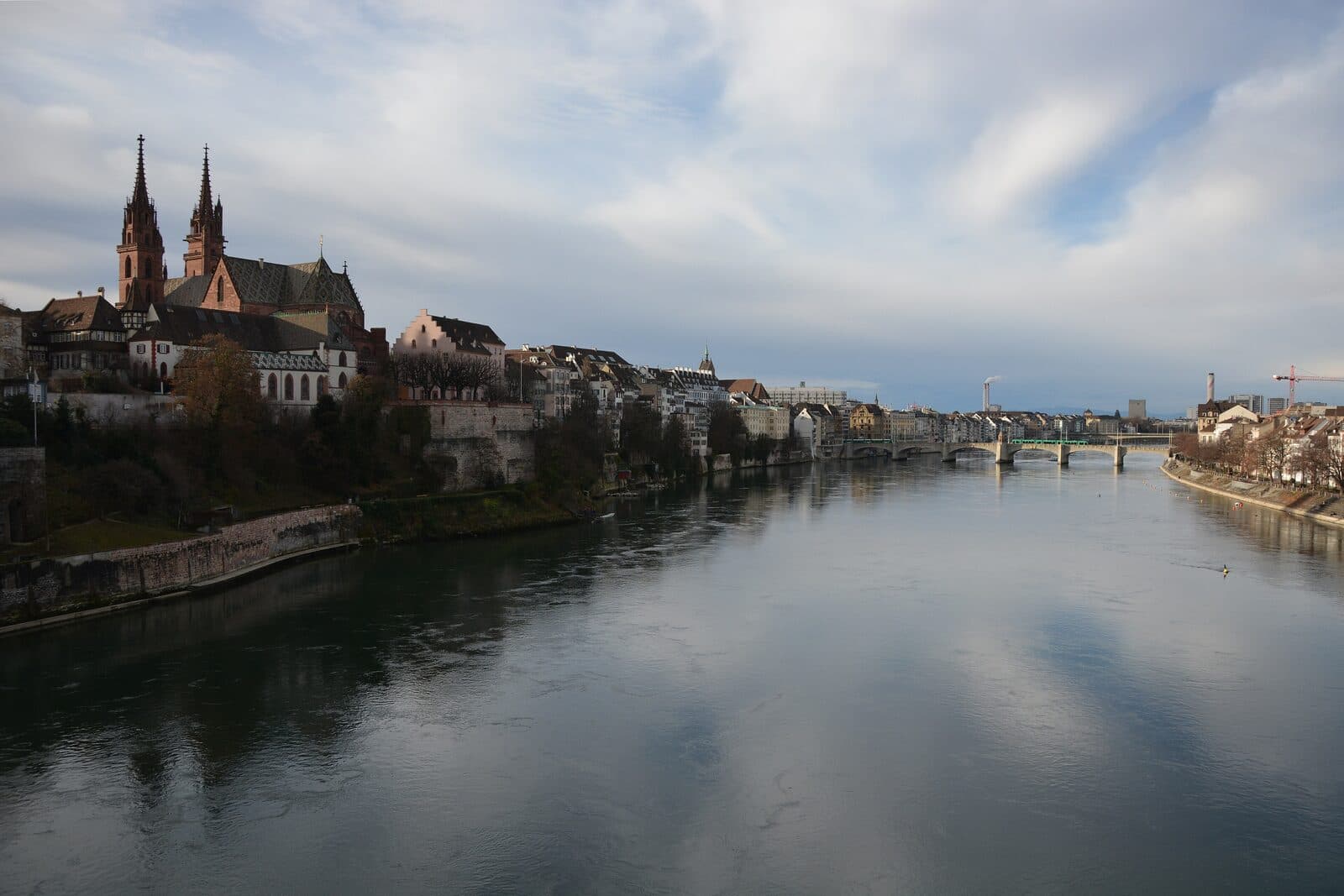
The Basel region — historically, economically and functionally a single trinational area for living, working and research — is, under constitutional law, divided into two autonomous cantons: Basel-Stadt (BS) and Basel-Landschaft (BL). The division goes back to the cantonal split of 1833, has not been reversed since then, and shapes migration law practice in that both cantons maintain their own migration authorities, their own bar supervisory commissions and, in part, different cantonal implementing rules. Functionally, however, the everyday reality of the migrant population living there is closely interwoven: one and the same commute regularly crosses several cantonal and national borders, the University of Basel is jointly run on a binational basis (BS and BL), and the pharmaceutical and life-sciences cluster (Roche, Novartis and others) extends across both cantons and the neighbouring countries (Germany, France).
Basel-Stadt comprises the city of Basel as well as the two rural municipalities of Riehen and Bettingen. The canton is among the most densely populated and most heavily urbanised cantons in Switzerland and, in intercantonal comparison, has a high proportion of persons without Swiss citizenship — in this respect it has for years been among the leading cantons, on the same order of magnitude as Geneva and ahead of Zurich. Current population and proportion figures are to be obtained from the Federal Statistical Office and the Statistical Office of the Canton of Basel-Stadt.
Basel-Landschaft comprises the five districts of Arlesheim, Liestal, Sissach, Waldenburg and Laufen. The canton has a lower proportion of foreign nationals than Basel-Stadt and thus lies closer to the Swiss average. The permit structure is mixed: a residential population near the agglomeration made up of pharmaceutical and service-sector commuters, a classic residential population in the suburban municipalities (Allschwil, Binningen, Münchenstein, Pratteln, Muttenz, Reinach) and a rural population in the upper valleys. Current figures are to be obtained from the Federal Statistical Office and the Statistical Office of the Canton of Basel-Landschaft.
As a shared living space, the two Basel are home to a notable migrant population. In addition, there is a large number of cross-border commuters from Germany (district of Lörrach, Weil am Rhein, Rheinfelden BW, district of Bad Säckingen) and France (Saint-Louis, Huningue, Mulhouse agglomeration), who are gainfully employed mainly in BS and, to a lesser extent, in BL. The exact cross-border commuter figures are published quarterly by the Federal Statistical Office (cross-border commuter statistics CBCS).
Migration law matters are handled in the two cantons by a separate competent authority in each case. Address, opening hours, fees and processing times may change; the official authority website is authoritative in each case:
Migrationsamt Kanton Basel-Stadt Official website (address, opening hours, contact form, fees, processing time): https://www.migrationsamt.bs.ch Topic portal: https://www.bs.ch (Topics → Foreign nationals) Indicative processing time (per the authority's statement): around 6 weeks for common procedures — the authority's current statement is authoritative.
Amt für Migration Kanton Basel-Landschaft Seat: Liestal (part of the Sicherheitsdirektion BL) Official website (address, opening hours, contact): https://www.baselland.ch (Politics and authorities → Sicherheitsdirektion → Migrationsamt)
The BL cantonal administration is organisationally spread across several locations in Liestal; the exact business address and accessibility of the Amt für Migration BL is therefore to be retrieved via baselland.ch before any contact is made.
1.1 Migration structure in the two Basel — structural particularities
In intercantonal comparison, the Basel region presents a number of structural particularities that affect migration law practice:
- Share of highly qualified persons in the life-sciences sector: The global headquarters of Roche and Novartis as well as numerous other life-sciences companies (including Lonza, Bayer sites, Syngenta) result in an above-average number, in intercantonal comparison, of third-country permits for highly qualified persons under the Federal Act on Foreign Nationals and Integration (FNIA, SR 142.20), in particular under Art. 23 FNIA (managers, specialists with particular professional qualifications). The specific permit-granting practice and its duration are to be clarified with the Migrationsamt Basel-Stadt.
- University of Basel — jointly run on a binational basis: The University of Basel is a joint institution of the cantons of BS and BL. It attracts a large student and research population from Germany (in particular Baden-Württemberg) as well as from third countries. Students typically receive a B residence permit for study under Art. 27 FNIA; after completing their studies, an extension of six months for job-seeking is possible (Art. 21 para. 3 FNIA in conjunction with the Ordinance on Admission, Residence and Gainful Employment (OASA, SR 142.201)).
- German commuters / cross-border commuters: Owing to the immediate border with Germany, the G cross-border permit population is high in the Basel region. In addition, there are B residence permit constellations (German nationals resident in BS/BL).
- EuroAirport Basel-Mulhouse: The trinational airport is located on French soil but is operated binationally by Switzerland and France. It gives rise to its own migration law situations (employees in the aviation sector with cross-border places of deployment).
- Asylum function: Both Basel are reception cantons in the distribution key of the State Secretariat for Migration (SEM); the contingents are distributed according to the population key (Asylum Ordinance 1 in conjunction with the Asylum Act, AsylA, SR 142.31). The federal asylum centre (FAC) for the Northwestern Switzerland region is operated in the region; cantonal asylum accommodation structures exist in BL.
2. Legal foundations — federal law and cantonal implementing law
2.1 Applicable federal law
Both cantons apply — like all cantons — federal law as a priority: the Federal Act on Foreign Nationals and Integration (FNIA, SR 142.20), the Ordinance on Admission, Residence and Gainful Employment (OASA, SR 142.201), the Agreement on the Free Movement of Persons (AFMP, SR 0.142.112.681) with its implementing ordinances, the Asylum Act (AsylA, SR 142.31) as well as the relevant practice and directives of the SEM. For the federal legal foundations, see the AIG/VZAE terminology glossary, the FZA/VFP glossary and the Asylum Act glossary.
2.2 Cantonal implementing law — Basel-Stadt
At cantonal level in BS, the following are particularly relevant:
- Advokaturgesetz (AdvokG, SG 291.100): Governs the legal profession (Advokatur) in the Canton of Basel-Stadt, in particular admission to the bar register and the activity of the Anwaltsaufsichtskommission Basel-Stadt.
- Cantonal implementing provisions on the FNIA: govern cantonal competences, the course of the procedure and individual matters such as the integration agreement at cantonal level. The exact designation and SG numbering are to be obtained via the systematic compilation of laws of the Canton of Basel-Stadt (gesetzessammlung.bs.ch).
- Constitution of the Canton of Basel-Stadt (KV-BS): Basis for the communal voting rights of foreign nationals in the city of Basel (see section 9).
- Cantonal citizenship law of Basel-Stadt: Cantonal concretisation of the naturalisation procedure in implementation of the federal Swiss Citizenship Act (SCA, SR 141.0).
2.3 Cantonal implementing law — Basel-Landschaft
At cantonal level in BL, the following are particularly relevant:
- Anwaltsgesetz (AnwG BL): Governs the legal profession in the Canton of Basel-Landschaft, in particular admission to the bar register and the activity of the Aufsichtskommission über die Rechtsanwältinnen und Rechtsanwälte BL. The exact designation and SGS numbering are to be obtained via the systematic compilation of laws of the Canton of Basel-Landschaft (bl.clex.ch).
- Cantonal implementing provisions on the FNIA.
- Constitution of the Canton of Basel-Landschaft (KV-BL).
- Cantonal citizenship law of Basel-Landschaft (in implementation of the SCA, SR 141.0).
The cantonal enactments with a migration nexus for both Basel are to be obtained via the respective systematic compilation of laws (gesetzessammlung.bs.ch or bl.clex.ch respectively).
2.4 Autonomous supervision — two separate bar registers
A central consequence of the constitutional separation is that BS and BL each maintain their own cantonal bar register and each their own supervisory commission. A lawyer entered in the BS register is not automatically entered in the BL register — and vice versa. In practice, many lawyers of the Basel economic area are entered in both registers, which allows representation across the cantonal border without professional-practice complications. The intercantonal free movement of lawyers is governed under federal law by the Federal Act on the Free Movement of Lawyers (LLCA, SR 935.61). For the marketplace intermediation of SIP-v3, this dual registration is relevant in practice (see section 13).
3. Structure and sections — migration authorities of both Basel
3.1 Migrationsamt Basel-Stadt
The Migrationsamt Basel-Stadt is organised by specialist areas. The following presentation serves as rough orientation; the exact internal organisation and the directorate assignment may change and are to be retrieved via migrationsamt.bs.ch.
- EU/EFTA Residence area: B, C, L and G permits for nationals of EU and EFTA states under the AFMP.
- Third-country Residence area: B, C, L permits for third-country nationals under the FNIA; in particular family reunification, gainful employment (with a focus on highly qualified life-sciences specialists), study.
- Asylum area: procedures relating to F, N and S permits, coordination with the FAC Northwestern Switzerland and the cantonal asylum accommodation structures.
- Naturalisation area: processing of citizenship applications at cantonal level; coordination with the citizenship bodies of the three BS municipalities of Basel, Riehen and Bettingen.
- Hardship and special-procedures area: hardship cases under Art. 30 para. 1 let. b FNIA, coordination of removal enforcement.
3.2 Amt für Migration Basel-Landschaft
The Amt für Migration BL is part of the Sicherheitsdirektion BL with its seat in Liestal. The structure is organised according to functional areas similar to those in BS (EU/EFTA Residence, Third-country Residence, Asylum, Naturalisation, Hardship). The current internal organisation is to be retrieved via baselland.ch.
3.3 Cooperation BS–BL and with other authorities
Despite the constitutional separation, there is well-established technical cooperation between the two migration authorities. In the case of intercantonal moves within the Basel region (e.g. relocation of domicile from Basel-Stadt to Allschwil or vice versa), the cantonal migration offices are connected to one another via the official registration data and the Central Migration Information System (ZEMIS). A registration of arrival in the new municipality of domicile is mandatory within the statutory time limit (as a rule 14 days), including in the case of intercantonal moves; the permit is then reissued at the new domicile. The exact registration time limit is to be enquired about with the relevant residents' registration office.
4. Pharmaceutical and economic effect on migration practice
The economic concentration of the life-sciences industry in Basel has a direct, practically relevant effect on the handling of migration law matters.
4.1 Roche, Novartis and the highly qualified segment
The sites of Roche and Novartis in Basel generate a continuous demand for third-country permits for highly qualified persons under Art. 23 FNIA (managers, specialists with particular qualifications) as well as under Art. 21 para. 3 FNIA (admission in the overall economic interest). In practice, this means that the Migrationsamt BS communicates as a matter of routine with the HR and mobility departments of large companies. The specific processing time depends on the completeness of the documents, the workload and the individual case, and is to be clarified with the authority.
The typical profiles include: researchers with a doctorate in life sciences, physicians in clinical research, specialists in regulatory affairs, manufacturing professionals as well as managers. SEM approval under Art. 99 FNIA is the rule in these constellations; the cantonal preliminary examination and the obtaining of approval by the Migrationsamt proceed along well-established lines.
Anti-Scope: SwissImmigrationPro does not provide procedural advice for pharmaceutical companies or their HR departments. These procedures are typically handled by in-house mobility departments or specialised law firms.
4.2 University of Basel and student migration
The University of Basel is a university jointly run on a binational basis by BS and BL, with a notable, partly foreign student and research population (in particular from Germany, Italy, Austria, France as well as various third countries). Students receive a B residence permit for study under Art. 27 FNIA. For third-country nationals, the requirements under Art. 23 OASA must be met (secured means of subsistence, prospect of completing studies, departure after the end of studies). After successful completion of studies, an extension of six months for job-seeking under Art. 21 para. 3 FNIA in conjunction with Art. 21 OASA is possible.
For the in-depth presentation of study-related permits, see the B residence permit for study.
4.3 Cross-border commuters from Germany and France
The G cross-border permit is of great importance in the Basel region. A notable number of cross-border commuters are active in the Basel economic area, most of them resident in the German districts of Lörrach, Bad Säckingen and Waldshut as well as in the French department of Haut-Rhin. The current figures are published by the Federal Statistical Office (cross-border commuter statistics).
The G cross-border permit is based, for EU/EFTA nationals, on the AFMP, and for third-country nationals on the ordinary FNIA provisions (Art. 35 FNIA) with the additional requirement of a permanent right of residence in the neighbouring state and at least six months' residence in the border zone. For tax purposes, the respective double-taxation agreements apply to cross-border commuters (for Germany the DTA Germany–Switzerland, for France the relevant agreement with the special cross-border commuter regime). The specific tax treatment is to be clarified with the competent tax administration.
Anti-Scope: SIP is not a tax advisory service. The exact constellation in the taxation of cross-border commuters is to be clarified with the relevant tax administration (tax administration BS, tax administration BL) and/or qualified tax advice.
5. Basel-Stadt — specific practice points
5.1 Language proof
For the granting of a B residence permit in family reunification from a third country as well as for the extension in individual constellations, BS practice requires proof of German at least at the level provided for under federal law according to the Common European Framework of Reference (CEFR). For the early granting of the C settlement permit after five instead of ten years (Art. 34 para. 4 FNIA in conjunction with Art. 60a OASA), a higher language level is as a rule required (typically B1 oral and A1 written in German).
The fide certificate in German is accepted as officially recognised proof. In addition, the diplomas and certificates referred to in Art. 77d OASA apply. The exact requirements of BS practice are to be clarified with the Migrationsamt Basel-Stadt, since cantonal interpretations may in individual points deviate from the federal minimum standard.
5.2 Integration agreement
Under Art. 58a FNIA, the canton may conclude an integration agreement with third-country nationals who exhibit integration deficits. BS practice uses this instrument in a restrained and case-by-case manner. An integration agreement typically comes into consideration when, upon an extension, deficits are identified in the area of language, gainful employment or public order.
5.3 Hardship case under Art. 30 para. 1 let. b FNIA
The assessment of a hardship case is carried out under Art. 31 OASA on a case-by-case and discretionary basis, on the basis of the criteria of integration, family circumstances, financial situation, duration of residence, state of health as well as reintegration possibilities in the state of origin. The outcome is open and depends entirely on the individual case; a blanket statement about the prospects of success is not possible.
Anti-Scope: SwissImmigrationPro provides no strategic advice on the argumentation of a hardship application. The case-dependent presentation of evidence and the interpretation of the indeterminate legal concepts belong to the practice of the legal profession and are to be handled via the cantonal legal profession (BS Advokatur, BL legal profession).
5.4 Early C settlement permit
The early granting of the C settlement permit after five instead of ten years (Art. 34 para. 4 FNIA) presupposes successful integration and lies within the discretion of the cantonal authority. The decisive factors are enhanced language skills (typically B1 oral, A1 written), economic self-sufficiency, orderly financial circumstances and the absence of significant criminal incidents. Reliable cantonal granting quotas are not publicly published; a quantitative statement about the prospects of success is therefore not possible.
5.5 Family reunification — BS interpretation
In family reunification from third countries (Art. 43–47 FNIA), the Migrationsamt BS examines the cumulative requirements: sufficient earned income, appropriate housing, no dependence on social assistance, language. The BS interpretation orients itself on the federal standard, with consideration of the urban housing-market reality (Basel has a tight housing market).
5.6 Practice in the case of separation and divorce
In the case of separation or divorce from Swiss citizens or holders of a C settlement permit, Art. 50 FNIA applies. The requirements are examined carefully: three-year marital union and successful integration (Art. 50 para. 1 let. a FNIA) or important personal reasons (Art. 50 para. 1 let. b FNIA, in particular domestic violence). For the in-depth presentation, see Separation and divorce (Art. 50 AIG).
5.7 Naturalisation in Basel-Stadt
The naturalisation procedure in BS follows the three-tier Swiss logic (federal, cantonal, communal). At federal level, the requirements of the Swiss Citizenship Act (SCA, SR 141.0) apply — in particular the ordinary duration of residence under Art. 11 SCA (in conjunction with the crediting rule of Art. 9 para. 2 SCA, according to which certain years are credited) as well as the integration criteria under Art. 12 SCA. The required language level (as a rule B1 oral, A2 written) follows from the Swiss Citizenship Ordinance (SCO, SR 141.01), in particular from its Art. 6 (SR 141.01); accepted proofs are the fide certificate as well as the diplomas referred to in Art. 6 para. 2 (SR 141.01) of the Citizenship Ordinance.
The communal naturalisation procedures in the three BS municipalities (Basel, Riehen, Bettingen) have been modernised in recent years. The municipal-assembly vote on individual applications, formerly customary in some Swiss municipalities, is not the usual practice in the BS municipalities. The respective current communal practice is to be clarified with the competent municipality.
6. Basel-Landschaft — specific practice points
6.1 Language proof
In family reunification from third countries, BL practice requires proof of German at the minimum level provided for under federal law. For the early C permit, a higher level applies as a rule (typically B1 oral, A1 written). The exact requirements are to be clarified with the Amt für Migration BL.
6.2 Integration agreement
BL practice on the integration agreement under Art. 58a FNIA is case-by-case: individual procedures are provided with an integration agreement; a systematised use is not evidently documented.
6.3 Hardship case
BL hardship practice under Art. 30 para. 1 let. b FNIA essentially orients itself on the federal standard. A pronounced cantonal particularity is not evidently documented in BL. The outcome of a hardship application depends entirely on the individual case.
6.4 Early C settlement permit
BL practice on the early granting of the C permit after five years follows the federal standard (Art. 34 para. 4 FNIA). An official cantonal quota is not publicly published.
6.5 Naturalisation in Basel-Landschaft
The naturalisation procedure in BL follows the three-tier logic. At cantonal level, the cantonal citizenship law concretises the requirements in implementation of the SCA (SR 141.0); at communal level, the respective municipal regulations apply. In individual BL municipalities there are communal hearing and assessment practices that may differ from municipality to municipality. The respective communal practice — and the current number of municipalities of the canton — is to be clarified via baselland.ch or with the competent municipality.
7. Return counselling Basel-Stadt — a cantonal particularity (load-bearing)
Rückkehrberatung Basel-Stadt Official website (address, contact, opening hours, languages): https://www.rueckkehrberatung-bs.ch/ Responsible body: Canton of Basel-Stadt
7.1 What the BS return counselling does differently
While the cantonal return counselling services of other cantons (e.g. Zurich, Bern, Geneva) are often predominantly oriented towards persons with an asylum background and advise in the asylum and removal procedures there, the BS return counselling is expressly competent also for foreign nationals who, independently of the asylum context, harbour a wish to return or strive for an orderly end of residence. This includes:
- Third-country nationals with a B, C, L or Ci permit who wish to end their residence voluntarily (e.g. after retirement, upon return to the state of origin for family reunification there, upon a change of job abroad)
- Persons who, on account of Schengen overstay or residence problems (e.g. expired visa, failed registration, illegal residence), are seeking an orderly solution
- Asylum persons with or without a rejected asylum application
- Persons with health, social or family reasons for return
The counselling is, according to the service's statement, free of charge and available in several languages; the current range of languages and the counselling offer can be retrieved via rueckkehrberatung-bs.ch.
7.2 Practical relevance for SIP
For SIP, this service is relevant when a client has a Schengen overstay constellation to clarify or is planning a voluntary end of residence without an asylum background. The cross-reference to the Schengen overstay is therefore mandatory (see section 15).
Anti-Scope: The BS return counselling is a state counselling service, not a law firm. It provides information, triage and logistical support (travel documents, tickets, connection to return-aid organisations), but no representation under foreign-nationals law before authorities or courts. For legal representation in the return context (e.g. defence against a removal decision, hardship argumentation), the legal profession is competent.
8. Asylum in both Basel
8.1 Federal asylum centre Northwestern Switzerland
The federal asylum centre (FAC) for the Northwestern Switzerland region comprises a procedure centre as well as further locations. Asylum applications are, from the time of submission, processed in the accelerated procedure under Art. 26b AsylA (SR 142.31) and the subsequent provisions, which takes place within the federal centre. Legal representation in the accelerated procedure is provided by the legal representation mandated by the SEM at the federal asylum centre.
8.2 Extended procedure — cantonal allocation
If an asylum application is not decided in the accelerated procedure and is transferred to the extended procedure (Art. 26d AsylA), allocation to a canton takes place according to the SEM's distribution key. BS and BL each take in, in accordance with their population size, a share of the extended procedures. During the extended procedure, the asylum-seeking person lives in the canton concerned and is registered there with the authorities; legal counselling switches to the cantonal legal counselling service mandated by the SEM under Art. 102f AsylA.
8.3 Legal counselling services for asylum in both Basel
The counselling services active in both Basel and operating in the field of asylum include in particular:
-
HEKS Rechtsberatungsstelle für Asylsuchende beider Basel (BAS) Official website: https://www.heks.ch/was-wir-tun/rechtsberatung-asylsuchende-beider-basel Responsible body: Hilfswerk der Evangelischen Kirchen Schweiz (HEKS) Activity: counselling and legal representation in asylum and removal procedures for both cantons
-
Freiplatzaktion Basel Responsible body: Verein Freiplatzaktion Basel Activity: social and legal counselling for asylum seekers, sans-papiers and migrant persons affected by poverty
-
Beratungsstelle für Asylsuchende im Kanton Basel-Landschaft Activity: legal counselling for asylum seekers in the Canton of BL during the extended procedure
A complete and current list of the mandated legal counselling services is maintained by the Swiss Refugee Council (SRC); the current list is to be retrieved via its website.
For the in-depth presentation of asylum law, see the Asylum Act glossary.
8.4 Women's shelter and protection against domestic violence
The Frauenhaus beider Basel is the central protective facility for women and children affected by domestic violence in the Basel economic area. It is a facility jointly run by BS and BL and admits women regardless of residence status, nationality and insurance status.
Frauenhaus beider Basel Official website (emergency number, contact): https://www.frauenhaus-basel.ch/ Anonymous locations (not public for protection reasons) Responsible body: jointly BS/BL
For migrant persons with a B, Ci or L permit, recourse to the protective services of the women's shelter is relevant under migration law, since Art. 50 para. 1 let. b FNIA and Art. 50 para. 2 FNIA provide for marriage-independent residence permits where domestic violence is demonstrable. The place of protection is coordinated with the foreign-nationals law assessment via the cantonal victim support (based on the Victim Support Act, VSA, SR 312.5).
9. Voting rights in Basel-Stadt — special case in intercantonal comparison
A BS particularity that is frequently overlooked in migration counselling: In the city of Basel, under certain conditions, holders of a C settlement permit have communal voting and electoral rights at municipal level. The rule follows from the Constitution of the Canton of Basel-Stadt and concerns the active right to vote in municipal affairs of the residents' municipality of the city of Basel.
IMPORTANT RESTRICTION: The exact requirements (duration of residence in Switzerland, duration of domicile in the municipality, further criteria) as well as the precise scope (election of the legislature, executive, voting rights in ballots) are to be clarified with the competent cantonal office (voting-eligibility or electoral office), since the interpretation may differ in detail and the rule may have changed since the respective constitutional revision.
The other two BS municipalities (Riehen, Bettingen) regulate communal voting rights autonomously; practice may diverge here.
In Basel-Landschaft there are no communal voting rights for foreign nationals — neither at cantonal nor at communal level. In Switzerland, only individual cantons have foreign-nationals voting rights rules (in particular the French-speaking cantons of Jura, Neuchâtel, Vaud, Geneva and Fribourg as well as — at communal level — Graubünden and Appenzell Ausserrhoden; at communal level additionally the city of Basel). The current state is to be verified with the relevant cantonal office.
10. Tax status — BS and BL in comparison
Note (Anti-Scope): This section describes the migration-law-relevant fundamentals of taxation. SwissImmigrationPro provides no tax advice and gives no recommendation on the choice of domicile for tax reasons. The tax administrations BS and BL as well as qualified tax advice are authoritative.
10.1 Cantonal tax differences
The cantonal and communal tax burden differs between Basel-Stadt and Basel-Landschaft. Specific, current burden comparisons are published by the Federal Tax Administration (tax burden statistics) as well as by the cantonal tax administrations. SIP makes no assessment as to which canton is fiscally "cheaper" or "more attractive" — this is a personal decision that, deliberately, does not constitute a migration counselling topic.
10.2 Withholding tax for third-country B permit holders
Foreign employees without a C settlement permit (in particular B permit holders) are typically subject to withholding tax on their earned income. The withholding taxation of earned income is a cantonally levied tax; the withholding tax rates and the assessment are governed by cantonal tax law (for BS and BL the respective cantonal tax act) within the framework of harmonised tax law. Where gross earned income exceeds the relevant threshold (in practice CHF 120,000 per year), a mandatory subsequent ordinary assessment (SOA) takes place. The specific tariff classification and any correction or refund applications are to be clarified with the competent cantonal tax administration.
10.3 Cross-border commuters — special tax status
For German cross-border commuters, the DTA Germany–Switzerland with a special cross-border commuter rule applies; for French cross-border commuters, the relevant agreement with France applies. The tax administrations BS and BL administer these special regimes. The specific treatment in the individual case is to be clarified with the competent tax administration.
Anti-Scope: SwissImmigrationPro is not a tax advisory service. For specific questions, the tax administration of Basel-Stadt or the tax administration of Basel-Landschaft (accessible via bs.ch or baselland.ch respectively) or qualified tax advice should be consulted. SIP also gives no recommendation on the choice of canton of domicile (BS or BL) for tax reasons — this is a personal decision that, deliberately, does not constitute a migration counselling topic.
11. Procedure duration
The typical procedure durations at the migration authorities BS and BL depend on the state of the file, the completeness of the submitted documents, the workload of the section and the complexity of the case, and can vary considerably. Binding indicative values are not publicly published as service-level requirements. The Migrationsamt Basel-Stadt cites for common procedures an orientation figure of around 6 weeks; for all other procedures and for BL, the current statement of the competent authority is authoritative.
Note: SEM approval of cantonal preliminary decisions (Art. 99 FNIA) is not included in these orientation figures and may require additional time. The respective current statements are to be retrieved via migrationsamt.bs.ch or baselland.ch.
12. Appeal procedure against Migrationsamt decisions
12.1 Basel-Stadt
A decision of the Migrationsamt BS (refusal, revocation, removal) is not final. The cantonal legal recourse is structured in several tiers; the exact tiering, the designations and the competences of the BS appeal instances are canton-specific and are to be retrieved via bs.ch. As a rule, the path runs via an appeal to the competent cantonal instance (department or administrative court; in BS, the Court of Appeal acts as the administrative court). Against cantonal decisions of last instance, the appeal to the Federal Supreme Court is open, insofar as the Federal Supreme Court Act (FSCA, SR 173.110) so provides — in particular under its Art. 82 (SR 173.110) and the subsequent provisions.
The appeal time limits are governed by cantonal procedural law; they are typically 30 days from notification of the decision. The time limit applicable in the individual case follows bindingly from the instructions on legal remedies of the contested decision.
12.2 Basel-Landschaft
In BL, legal recourse is structured similarly: appeal to the cantonal appeal instance (as a rule the Cantonal Court BL as the administrative court), followed by appeal to the Federal Supreme Court, insofar as the FSCA (SR 173.110) so provides (Art. 82 (SR 173.110) and subsequent provisions). The appeal time limit is typically 30 days; the instructions on legal remedies of the decision are authoritative. The exact tiering and designation are to be retrieved via baselland.ch.
Anti-Scope: SwissImmigrationPro provides no appeal strategy. The choice of legal basis, the argumentation, the selection of evidence and timely submission belong to the practice of the legal profession. See the appeal pathway against decisions of the cantonal migration authorities for the Switzerland-wide methodology and section 13 of this file for the legal profession of both Basel.
13. Legal profession of both Basel — Advokatur, legal profession, supervision
13.1 Autonomous supervisory commissions
As already set out in section 2.4: BS and BL each maintain their own supervisory commissions over the legal profession.
-
Anwaltsaufsichtskommission Basel-Stadt Legal basis: Advokaturgesetz Basel-Stadt (AdvokG, SG 291.100) as well as the LLCA (SR 935.61) Mandate: supervision of the lawyers entered in the BS bar register Contact: to be retrieved via the official cantonal authority website (bs.ch / gerichte-bs.ch)
-
Aufsichtskommission über die Rechtsanwältinnen und Rechtsanwälte Basel-Landschaft Legal basis: Anwaltsgesetz BL (AnwG BL) as well as the LLCA (SR 935.61) Mandate: supervision of the lawyers entered in the BL bar register Contact: to be retrieved via the official cantonal authority website (baselland.ch)
13.2 Professional organisations
In addition, there are private professional organisations:
- Advokatenkammer Basel (BS) — private professional organisation of the Basel lawyers.
- Anwaltsverband Basel-Landschaft (BL) — private professional organisation of the BL lawyers.
Membership in these associations is not mandatory, but in practice it is widespread.
13.3 The term "Advokatur" in Basel-Stadt
A linguistic particularity: in Basel-Stadt the legal profession is historically called Advokatur (from the Latin advocatus), and the admitted practitioners are designated as Advokatinnen und Advokaten (and not as "Rechtsanwältinnen und Rechtsanwälte"). The legal basis is the Advokaturgesetz BS (AdvokG, SG 291.100). Functionally and in intercantonal dealings, however, there is no difference from the legal profession customary in other cantons; the free movement under the LLCA (SR 935.61) is guaranteed.
13.4 The SIP-v3 marketplace and both Basel
14. Crisis pathway in both Basel
- 143 — Die Dargebotene Hand (24h, DE/FR/IT). German-language line directly accessible for the Basel region.
- 147 — Pro Juventute (counselling for children and young people, 24h).
- Opferhilfe beider Basel — cantonal victim support office (VSA, SR 312.5) for persons affected by violence, coordinated with the foreign-nationals law assessment.
- Frauenhaus beider Basel — 24h emergency line via frauenhaus-basel.ch; protective accommodation regardless of residence status.
- HEKS BAS — legal counselling for asylum seekers — accessible via heks.ch; active in the field of asylum of both Basel.
- Freiplatzaktion Basel — social and legal counselling for asylum seekers, sans-papiers and migrant persons affected by poverty.
- Rückkehrberatung Basel-Stadt — accessible via rueckkehrberatung-bs.ch; counselling for voluntary return, explicitly also outside the asylum context (see section 7).
For the complete crisis-card structure, the Switzerland-wide crisis guidance from SwissImmigrationPro applies.
15. Cross-references
This cantonal focus on both Basel ties in with several framework and topic files. Recommended cross-references:
- The AIG/VZAE terminology glossary — federal legal foundations FNIA/OASA that the migration authorities BS and BL apply
- The Asylum Act glossary — asylum law, FAC practice, legal counselling mandate
- The glossary on the Citizenship Act 2018 (BüG) — naturalisation procedure, language and integration requirements
- The FZA/VFP glossary — AFMP free movement of persons (relevant for German cross-border commuters as well as for EU/EFTA B/C holders in both Basel)
- The cantonal enactments with a migration nexus — to be obtained via the respective systematic compilation of laws (gesetzessammlung.bs.ch or bl.clex.ch respectively)
- The Canton of Geneva — comparison with Geneva practice
- The Canton of Zurich — comparison with Zurich practice
- The Canton of Bern — comparison with Bern practice
- The German-speaking standard-practice cantons — superordinate cluster overview of the German-speaking Swiss cantons (BS and BL are part of this cluster; the major focus supplements the cluster material)
- The B residence permit
- The C settlement permit
- The G cross-border permit (particularly relevant for German commuters)
- The Schengen overstay — Schengen overstay; load-bearing cross-reference to the BS return counselling (see section 7)
- The Separation and divorce (Art. 50 AIG)
- The appeal pathway against decisions of the cantonal migration authorities — appeal procedure methodology against Migrationsamt decisions
16. Anti-Scope — what SIP does not provide for BS and BL
For reasons of professional ethics (LLCA, SR 935.61), clarity and medium- to long-term credibility vis-à-vis clients and supervisory authorities, SwissImmigrationPro expressly keeps the following topics outside its scope of services:
- No canton-shopping strategy between BS and BL: SIP gives no recommendation as to whether a particular procedure "should" be conducted in BS or in BL. Competence follows the civil-law domicile under the Swiss Civil Code (Art. 23 CC, SR 210); a strategic relocation of domicile with a foreign-nationals law background may, under certain circumstances, be abusive. The choice of canton of domicile for tax reasons is likewise a personal decision on which SIP provides no advice.
- No Migrationsamt insider tips: SIP gives no tips on individual caseworkers of the migration authorities BS or BL, no "favourable" application timing, no informal practices or rumours about cantonal interpretation tendencies. The official procedural channels and published practice information are the only admissible sources.
- No pharma highly-qualified intermediation: SIP is not a mobility advisory service for Roche, Novartis or other life-sciences companies. These procedures are handled by in-house mobility departments or specialised law firms.
- No appeal strategy: The choice of legal remedies, the line of argument and the presentation of evidence belong to the practice of the legal profession (BS Advokatur, BL legal profession).
- No tax advice: Questions on withholding tax, SOA, international double taxation, cross-border commuter taxation or the BS/BL tax choice are to be answered by qualified tax advisers, the tax administration BS or the tax administration BL.
- No hardship-argumentation strategy: The assessment of the case-dependent prospects of success of a hardship application under Art. 30 FNIA in conjunction with Art. 31 OASA is a legal service of the legal profession.
- No sans-papiers strategy: Sans-papiers counselling belongs in the hands of specialised civil-society organisations (including Freiplatzaktion Basel, HEKS BAS, cantonal sans-papiers contact points) and lawyers.
17. Note on currency and reviewer reservation
Addresses, telephone numbers, opening hours, fees, processing times, population and proportion figures as well as cantonal quotas are volatile and are, in this draft version, deliberately referenced via the respective official authority or responsible-body website instead of being printed with specific values. Specific candidate values that could not be conclusively confirmed are stored as HTML comments with a print-block notice in the source text and are to be compared against the official source before clearance.