
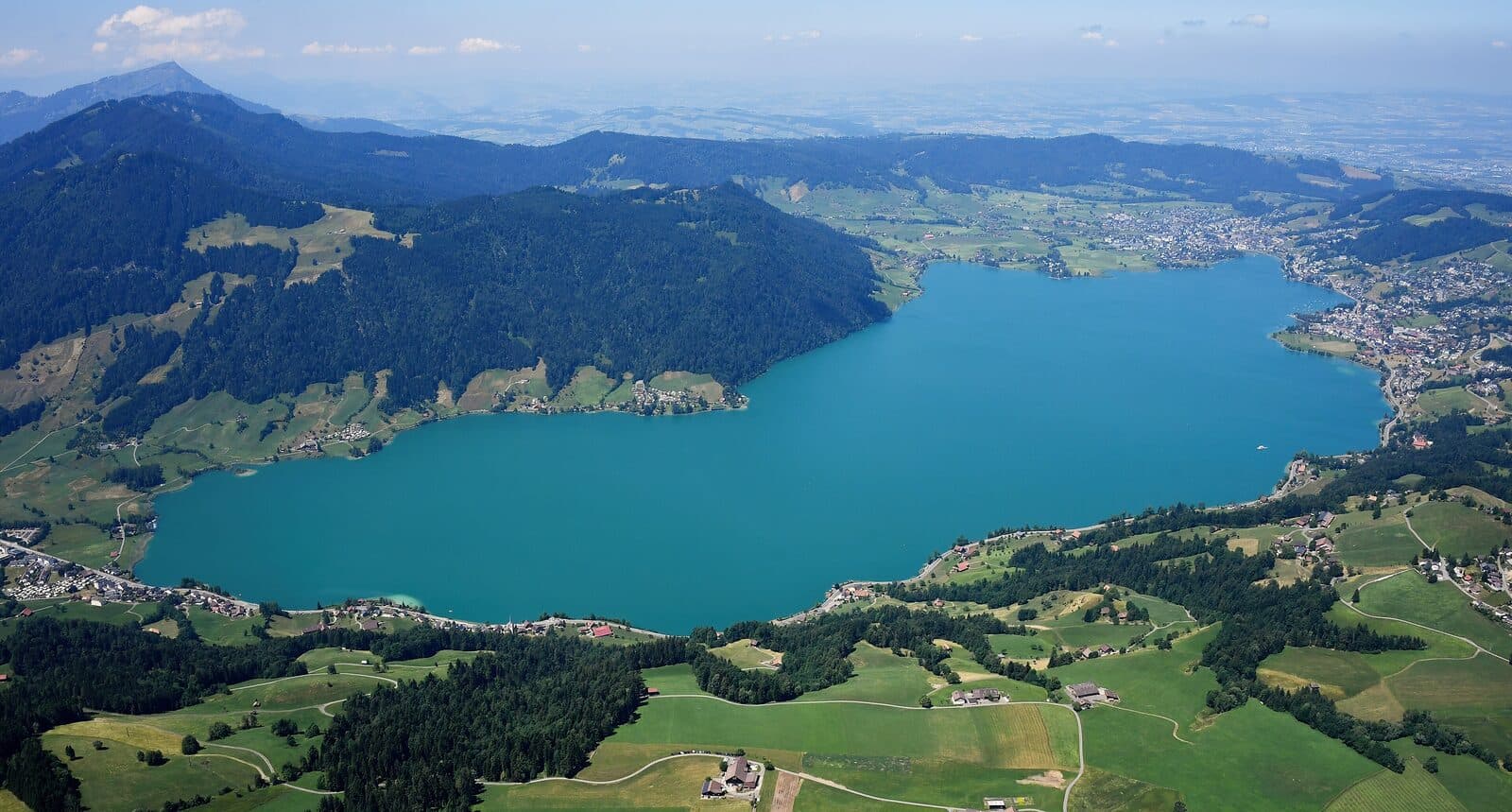
1. Overview — the Canton of Zug in the migration-law context
By area and population, the Canton of Zug is one of the smaller cantons of Switzerland, but in its migration-law profile it is a special case with disproportionate economic weight. In demographic terms it is among the smaller cantons; its share of persons of foreign nationality has for years been above the Swiss average and thus in the upper third of the cantons — clearly below Geneva in the relative proportion of foreigners, yet at a level comparable to Zurich. The current figures are governed by the population statistics of the Federal Statistical Office (FSO) as well as the cantonal statistical office; the specific values must be consulted there on a day-to-day basis.
The migration constellation in Zug differs structurally both from Geneva and from Zurich: whereas Geneva is shaped by the UN/IO sector and Zurich by its financial centre with a broad economic base, the Zug constellation is dominated by international commodities trading, the crypto and blockchain cluster ("Crypto Valley") as well as a dense network of holding companies and internationally active enterprises domiciled in the canton. This economic structure generates an above-average migrant population from the highly qualified segment — namely third-country nationals from the banking, trading, tech and crypto sectors as well as EU/EFTA nationals from the corresponding branches.
The competent cantonal authority for all residence-law procedures is the Migration Office of the Canton of Zug (AfM ZG) within the Residents' Registration and Migration unit.
Migration Office of the Canton of Zug (AfM ZG) — the address, telephone, e-mail, counter hours and telephone hours can be found on the official authority page, where they are published in binding form and kept up to date daily: Official page: https://www.zg.ch/migration
For an in-person appearance, to arrange an appointment and for the contact details in force, please refer exclusively to the canton's official page. SwissImmigrationPro deliberately refrains from printing volatile contact details in order to avoid outdated information.
Indicative processing-time value: simple, fully documented applications are, based on experience, processed by the AfM ZG within a few weeks (indicative value in the order of around four weeks). Only the Office provides binding information on the status of a specific procedure; the values in section 6 are indicative values, not guaranteed deadlines.
1.1 The Zug migrant population in figures
Qualitative classification (the exact, current statistics must be consulted via the FSO and the cantonal statistical office): among foreign nationals, EU/EFTA nationals predominate, namely those from Germany, Italy, Portugal, France and Spain as well as, increasingly, from Eastern Europe. Significant third-country communities include, among others, the United Kingdom (post-Brexit), the USA, India, China, as well as persons from Turkey, Kosovo, North Macedonia and Sri Lanka. The B residence permit is the most frequent category and, in inter-cantonal comparison, shows an above-average share in the highly qualified segment (admission to gainful employment under Art. 18 FNIA [Federal Act on Foreign Nationals and Integration, SR 142.20] and the subsequent admission provisions); the C settlement permit follows in second place. L short-term permits are comparatively frequent in the trading and consulting sectors; G cross-border permits do occur but are numerically less dominant than in the cantons of Geneva, Ticino or Basel-Stadt. Ci permits are few in relation to Geneva (see section 5). F/N permits follow the allocation key of the State Secretariat for Migration (SEM) pursuant to Art. 27 AsylA (Asylum Act, SR 142.31).
2. Legal bases — federal law and cantonal implementing law
2.1 Applicable federal law
In migration law, the Canton of Zug applies — like all cantons — federal law as a priority: the Federal Act on Foreign Nationals and Integration (FNIA, SR 142.20), the Ordinance on Admission, Residence and Gainful Employment (OASA, SR 142.201), the Agreement on the Free Movement of Persons (AFMP, SR 0.142.112.681) and its associated implementing acts, the Asylum Act (AsylA, SR 142.31) as well as the relevant SEM practice and directives. For the legal basis see the glossary of FNIA and OASA terms, the AFMP/FMOPA glossary and the glossary of the Asylum Act.
2.2 Cantonal implementing law
At the cantonal level, the following are particularly relevant:
- Introductory Act to the Federal Act on the Freedom of Movement of Lawyers (EG BGFA ZG, BGS 163.1): cantonal implementation of the Federal Act on the Freedom of Movement of Lawyers (LLCA, SR 935.61); it governs, among other things, the cantonal bar register and the competence of the supervisory commission.
- Ordinance on Lawyers (Anwaltsverordnung ZG, BGS 163.4): implementing ordinance to the EG BGFA ZG.
- Administrative Procedure Act of the Canton of Zug (VRG ZG): cantonal procedural law for proceedings before the cantonal administrative authorities and the administrative court.
- Cantonal implementing provisions to the FNIA and the Asylum Act: the exact designation and the BGS numbering of the relevant cantonal implementing act must be consulted in the consolidated systematic collection of laws of the Canton of Zug (https://bgs.zg.ch), where the version in force is published in binding form.
- Cantonal Citizenship Act: concretisation of the citizenship procedure under the SCA at the cantonal level (see section 9).
A consolidated overview of the cantonal acts with a migration nexus can be found in the consolidated systematic collection of laws of the Canton of Zug (https://bgs.zg.ch).
3. Structure of the Zug Migration Office
The AfM ZG is organised as an office of the Security Directorate. Compared to the large administrative structures in Geneva (OCPM) and Zurich (Migration Office ZH, six-figure migrant population), it is organisationally considerably smaller. It handles the ordinary foreign-nationals-law procedures (B EU/EFTA, B third country, L, C, extensions and changes of status), family reunification (Art. 42 FNIA for reunification with Swiss nationals and the subsequent provisions, as well as Art. 44 FNIA for reunification with persons holding a residence permit), the coordination of naturalisations (see section 9) as well as, through the Returns Division (Measures), the asylum-specific enforcement of removal. The exact internal organisation and the contact details applicable to the individual divisions must be consulted on the official authority page (https://www.zg.ch/migration).
4. Zug practice points — what distinguishes the Canton of Zug in migration law
4.1 Proof of language skills — German
For the issuance of a B permit in family reunification from a third country, the AfM ZG requires proof of German at level A1 oral in accordance with the Common European Framework of Reference for Languages (CEFR), based on Art. 58a para. 1 let. c FNIA as well as the relevant provisions of the Ordinance on Admission, Residence and Gainful Employment (OASA, SR 142.201), namely Art. 77d OASA. For the early issuance of the C settlement permit after five years (Art. 34 para. 4 FNIA in conjunction with Art. 60a OASA), practice requires a level of B1 oral and A1 written in German.
In particular, the fide certificate in the German language as well as the diplomas and certificates named in Art. 77d OASA (for example telc, Goethe, ÖSD at the corresponding level) are accepted. In the Zug context, the standard German (High German) variant is decisive; Swiss German is not relevant for the examination. These requirements are a minimum order of federal law; the specific cantonal interpretation may vary on a case-by-case basis. The requirements in force must be enquired about with the AfM ZG.
4.2 Integration agreement — rarely used
Under Art. 58a FNIA and Art. 58b FNIA, the canton may conclude an integration agreement with third-country nationals who exhibit integration deficits, or issue an integration recommendation. According to the available indications, Zug practice uses these instruments rarely and on a case-by-case basis — unlike the Canton of Vaud, which is known for its systematic use of the integration agreement. A Zug integration agreement typically applies only where, in the case of an extension, clear deficits are identified in the areas of language, gainful employment or respect for public safety and order. The small size of the canton allows for comparatively individualised file management. Binding information on current handling is provided by the AfM ZG.
4.3 Hardship case under Art. 30 para. 1 let. b FNIA
According to the available indications, Zug hardship-case practice lies in the inter-cantonal mid-range: tending to be less accessible than the Geneva practice considered generous, while at the same time less restrictive than the more restrictively oriented German-speaking cantons. This classification is qualitative; what is decisive is always the case-by-case assessment of the AfM ZG. The assessment is carried out under Art. 31 OASA on a case-by-case and discretionary basis, according to the federal-law standard criteria — integration (language, work, social inclusion), family circumstances, financial situation, duration of stay, state of health as well as reintegration possibilities in the country of origin. The SEM approval requirement under Art. 99 FNIA must be observed and may substantially extend the overall duration of a hardship-case procedure.
Anti-Scope: SwissImmigrationPro provides no strategic advice on the argumentation of a hardship-case application. The case-specific presentation of evidence and the interpretation of the indeterminate legal concepts belong to legal practice and must be handled through the lawyers entered in the Zug cantonal bar register (see section 11).
4.4 Early C settlement permit — moderate practice
The early issuance of the C settlement permit after five years instead of ten (Art. 34 para. 4 FNIA) presupposes successful integration and lies within the discretion of the cantonal authority; there is no legal entitlement. According to the available indications, Zug practice is configured moderately: neither particularly restrictive nor particularly generous. Within the integration assessment, the following are particularly taken into account: enhanced language skills (B1 oral, A1 written), economic self-sufficiency without recourse to social assistance, orderly financial circumstances as well as respect for public safety and order. Reliable cantonal statistics on the grant rate are not publicly published; binding information on the individual case is provided by the AfM ZG.
4.5 Family reunification — Zug interpretation
In the case of family reunification from third countries (Art. 43–47 FNIA), the AfM ZG examines the cumulative requirements (earned income, adequate housing, absence of dependence on social assistance, language, integration) according to federal-law standards. The tight situation on the Zug housing market — which is among the most expensive in Switzerland — may play a role on a case-by-case basis in examining adequate housing. For the reunification of children, the differentiated age limit under Art. 47 para. 1 FNIA applies (in conjunction with Art. 73 OASA) as well as the reunification deadline regulated in the same provision; in the case of late applications, the AfM examines "important family reasons" (Art. 47 para. 4 FNIA, case-by-case Federal Supreme Court practice, for example BGE 137 I 284). The interpretation of these indeterminate legal concepts is carried out on a case-by-case basis.
4.6 Practice in the event of separation and divorce
In the event of separation or divorce from Swiss citizens or C settlement-permit holders, Art. 50 FNIA applies (three-year marital union + integration under para. 1 let. a; important personal reasons under para. 1 let. b, namely domestic violence). For victim-support coordination see section 13. Deep-dive: separation and divorce (Art. 50 FNIA).
4.7 Highly qualified segment and third-country B issuance
Because of the economic structure (holding location, commodities trading, crypto cluster), Zug sees an above-average number of third-country B applications in the highly qualified segment under the admission provisions for gainfully employed persons (Art. 18–25 FNIA). Cantonal practice has the corresponding routine. In particular, the priority of domestic and EU/EFTA workers (Art. 21 FNIA), the personal requirements (Art. 23 FNIA) as well as the salary and working conditions customary for the locality, profession and branch (Art. 22 FNIA) are examined; issuance takes place within the framework of the federal quotas (Art. 19 FNIA and Art. 20 FNIA).
Anti-Scope: SIP provides no information on how a specific third-country B submission could be "optimised" through wording, job description or salary structure. These design questions lie with employers, HR services and specialised legal practice.
5. IO practice in Zug — smaller scale than Geneva
Whereas Geneva is one of the largest locations of international organisations (IOs) worldwide and hosts a very large number of holders of an FDFA legitimation card together with Ci accompanying persons, the IO presence in Zug is small; in particular, there are no UN locations in Zug. The few relevant constellations relating to international organisations apply only selectively. The current roster of organisations with a headquarters agreement must be enquired about with the Federal Department of Foreign Affairs (FDFA).
The Ci permit is issued to accompanying persons (spouses, minor children) of holders of an FDFA legitimation card, provided they wish to be gainfully employed or to undergo training. Legal basis: Host State Act (HSA, SR 192.12) and Host State Ordinance (HSO, SR 192.121). In Zug the case numbers are considerably smaller than in Geneva, but the mechanics are identical. Deep-dive: the Ci permit for accompanying persons of international organisations.
With the development of the crypto/blockchain sector as well as the establishment of international non-governmental organisations in the fields of climate, digitalisation and standardisation, the IO-related population in Zug has, according to the available indications, grown, without there being structural comparability with Geneva. Binding figures must be consulted via the FDFA and the cantonal statistical office.
6. Procedural duration and Zug indicative values
The typical procedural durations at the AfM ZG are presented here as non-binding indicative values and may vary considerably depending on the state of the file, the completeness of the documents, the workload of the respective section and the complexity of the case. They are not guaranteed deadlines. As matters currently stand, there are no official, continuously published processing deadlines of the AfM ZG; binding information on the status of a specific procedure is provided solely by the Office (https://www.zg.ch/migration).
| Procedure | Indicative duration |
|---|---|
| B first application (family reunification, employment application) | 4–10 weeks |
| B extension | 2–6 weeks |
| C application, ordinary (after 10 years) | 6–12 weeks |
| C application, early (Art. 34 para. 4 FNIA, after 5 years) | 6–14 weeks |
| Family reunification (third country) | 8–16 weeks |
| Hardship case Art. 30 para. 1 let. b FNIA | 8–14 months |
| Citizenship application (municipal + cantonal + federal) | 18–30 months (overall procedure) |
| Appeal procedure, Administrative Court ZG | 6–18 months |
Note: SEM approval of cantonal preliminary decisions (Art. 99 FNIA) is not included in the above indicative values and may, in constellations subject to approval, require additional weeks to months.
6.1 Factors and acceleration
Factors determining procedural duration are in particular: the completeness of the file (requests for supplementary documents cost weeks); the SEM approval requirement under Art. 85 para. 2 OASA and Art. 86 OASA; the submission of proof of language skills (the procedure is suspended until subsequent submission); security and criminal-record clarifications in multi-country constellations; the quota situation in the third-country highly qualified segment. No formal acceleration is provided for; practically effective are written enquiries on the status of the procedure, indications of particular urgency, as well as — as a last resort and with legal assistance — an appeal for denial of justice or for unjustified delay to the administrative court under the VRG ZG.
Anti-Scope: SIP provides no template for acceleration letters or appeals for unjustified delay. These belong to legal practice.
7. Economic effect on migration practice
The economic structure of the canton affects migration practice in several respects. The structural features are: the Crypto Valley (a significant crypto and blockchain cluster with corresponding demand for third-country B permits for tech and financial personnel); commodities trading (several internationally active commodities-trading enterprises with their headquarters or a branch in the canton); the holding location (concentration of international group functions such as Treasury, Tax, Legal, M&A and Compliance). From these structures arises an above-average practice routine of the AfM ZG, relative to the size of the canton, in the area of third-country highly qualified B permits. This description serves to classify the practice and is not a location assessment.
8. Tax status and withholding tax in Zug
The cantonal and municipal tax burden in the Canton of Zug is comparatively low in inter-cantonal comparison; the relevant values and the inter-cantonal comparison must be consulted via the Federal Tax Administration (FTA) and the cantonal tax administration. This finding is a purely descriptive classification of the tax environment; it is neither a recommendation, nor a location assessment, nor a migration-law-relevant advantage (see the anti-scope notes in this section and in section 16). The migration-law assessment of an application does not depend on the tax burden of the canton of residence.
8.1 Withholding tax for third-country B-permit holders
Third-country nationals holding a B permit as well as EU/EFTA B-permit holders without a settlement permit are as a rule subject, for their earned income, to withholding tax (deduction of tax at source). Withholding taxation of earned income is regulated in the Federal Act on Direct Federal Taxation (DBG, SR 642.11) and — for cantonal and municipal taxes — in the Federal Act on the Harmonisation of Direct Taxes of the Cantons and Communes (StHG, SR 642.14); the details follow from the federal withholding-tax ordinance as well as the cantonal tax act. Where the annual gross earned income exceeds a threshold set by federal law (in the order of CHF 120,000 under the ordinance rule in force), an obligatory subsequent ordinary assessment (NOV) is carried out ex officio. For lower incomes, withholding tax has in principle a definitive effect; an NOV may, however, be carried out upon request. Upon entry into the C settlement permit or upon marriage to a Swiss citizen, the withholding-tax liability for earned income ends and ordinary tax assessment applies. In each case, the information provided by the cantonal tax administration is decisive and binding.
8.2 Expert tax holidays — former special arrangements
In the past, various cantons had special arrangements for highly qualified foreign specialists (expatriate deductions or flat rates). In the wake of the reforms of corporate and tax law as well as the adaptation of the federal expatriate ordinance, such special arrangements have been restricted and standardised in recent years. The current status and applicability in the individual case must be enquired about with the cantonal tax administration; SwissImmigrationPro provides no information on this.
8.3 Practical notes — Anti-Scope
The Zug tax administration is the competent authority for all questions surrounding withholding tax, NOV and the assessment of natural persons. For the migration-law assessment, the tax situation is relevant only indirectly: tax arrears or substantial indebtedness do not by themselves trigger a permit revocation. They may, however, play a role within the overall assessment of integration and respect for public safety and order, as well as from the standpoint of proportionality (Art. 96 FNIA); a permit revocation or a non-extension presupposes the existence of a statutory ground for revocation under Art. 62 FNIA and is based on a case-by-case weighing of interests.
Anti-Scope: SwissImmigrationPro is not tax advice and gives no recommendation to relocate residence for tax reasons. "Tax optimisation" through choice of residence is a tax-law question reserved to qualified tax advisers; it is at the same time delicate in migration-law terms, since taking up a fictitious residence motivated purely by tax considerations, without an actual shift of the centre of life, may be abusive (concept of residence under Art. 23 CC and Art. 24 CC in conjunction with the case law of the Federal Supreme Court).
9. Naturalisation in Zug
Naturalisation follows a three-tier procedure (Confederation, Canton of Zug under the cantonal Citizenship Act, municipality of residence). All three levels must be approved cumulatively.
At the federal level, a distinction must be drawn between two separate acts. The Swiss Citizenship Act (SCA, SR 141.0) — in force since 1 January 2018 — governs the substantive basic requirements: as a rule ten years of residence in Switzerland (Art. 9 SCA), successful integration as well as suitability (Art. 11 SCA) and the integration criteria (Art. 12 SCA); furthermore, there must be no endangerment of internal or external security. The Citizenship Ordinance (BüV, SR 141.01) — an implementing instrument to be distinguished from the act — concretises, in particular, the proof of language skills: in principle a level of B1 oral and A2 written in a national language is required (Art. 6 (SR 141.01) of the Citizenship Ordinance; in the Canton of Zug, German). The language requirement of the ordinance and the substantive requirements of the act (Art. 9 SCA, Art. 11 SCA and Art. 12 SCA) are two separate acts and must not be conflated. Deep-dive: glossary of the Swiss Citizenship Act 2018.
At the cantonal/municipal level, the Zug procedure requires several years' residence in the canton as well as in the municipality of residence; the exact requirements vary among the roughly eleven political municipalities and are regulated in the respective municipal regulations. The municipal hearing (citizenship commission) is, in most Zug municipalities, no longer a systematic part of the procedure and can only be carried out on a case-by-case basis. The practice is regarded as comparatively standardised in inter-cantonal comparison. At the cantonal level, a knowledge test (history, geography, civics) as well as an extract from the criminal record may apply. The cantonal and municipal naturalisation requirements in force must be consulted in the cantonal Citizenship Act in the consolidated systematic collection of laws of the Canton of Zug (https://bgs.zg.ch) as well as in the regulations of the competent municipality of residence; binding information is provided by the cantonal naturalisation office and the municipality of residence.
10. Voting rights and political participation in Zug
Unlike the cantons of Jura, Neuchâtel, Vaud, Fribourg (at the municipality's request), Geneva and Basel-Stadt (in restricted form), the Canton of Zug knows no municipal voting and election rights for foreigners. Even long-term C-permit holders resident in Zug have, neither at the municipal nor at the cantonal level, the active or passive election and voting right. In the Canton of Zug, the right to vote is tied to Swiss citizenship.
A cantonal popular initiative to introduce a municipal voting and election right for foreigners was rejected at the ballot box; the canton still does not know such a right. The current political status — including any new motions — must be consulted via the State Chancellery of the Canton of Zug and the business register of the Zug Cantonal Council.
In migration counselling, this constellation means — analogously to the situation in Zurich — that naturalisation is, for long-term resident third-country nationals and EU/EFTA nationals in Zug, the only path to political participation in Switzerland. The citizenship application in Zug is to that extent highly relevant in practice (section 9).
11. The bar in Zug — supervisory commission and LLCA register
Lawyers admitted in Zug are entered in the cantonal bar register of the Canton of Zug, which is kept at the High Court (Obergericht). Legal basis: LLCA, SR 935.61 as well as the cantonal implementation in the EG BGFA ZG (BGS 163.1) and in the Ordinance on Lawyers (BGS 163.4). In addition, there is the Zug Bar Association as a private professional organisation (membership is not mandatory).
Competent for professional supervision is the Supervisory Commission for the Lawyers of the Canton of Zug, which is organisationally located at the High Court of the Canton of Zug (commission secretariat at the High Court registry). The address, telephone, e-mail and counter hours of the High Court registry can be found on the official page of the High Court, where they are published in binding form and kept up to date daily:
- Official page: https://www.zg.ch/behoerden/gerichte/obergericht
SwissImmigrationPro deliberately refrains from printing volatile contact details in order to avoid outdated information.
Anti-Scope: SIP is not a law firm and does not replace any legal advice. The supervisory commission is not a counselling service for clients but a bar-law supervisory authority over lawyers.
12. Appeal procedure against AfM decisions
A decision of the AfM ZG (refusal of a permit, revocation, removal, negative hardship-case decision, etc.) is not final. Cantonal procedural law and federal law provide for a multi-tier legal remedy.
12.1 Step 1 — ruling of the Migration Office
The ruling of the AfM ZG opens the appeal route. The appeal deadline is typically 30 days from notification of the ruling; the deadline and appeal instance decisive for the specific subject matter of the dispute follow bindingly from the legal-remedies notice in the ruling and from the Administrative Procedure Act of the Canton of Zug (VRG ZG). Depending on the subject matter of the dispute, an internal administrative lower instance (for example the Security Directorate) may be provided for before the administrative court; the exact type of procedure is governed by the VRG ZG.
12.2 Step 2 — appeal to the Administrative Court of the Canton of Zug
Against the decision of the Security Directorate (or directly against the AfM decision, if a direct appeal is provided for), an appeal to the Administrative Court of the Canton of Zug is open. The deadline is typically 30 days. The administrative court is the highest cantonal administrative court and examines questions of fact and law. The deadline decisive in the individual case and the exact sequence of instances follow from the legal-remedies notice in the contested ruling and from the VRG ZG.
12.3 Step 3 — appeal to the Federal Administrative Court
In certain foreign-nationals-law constellations — namely where the Confederation (SEM) has acted as the lower instance — the Federal Administrative Court (FAC), seated in St. Gallen, may be competent. The deadline is 30 days (Art. 50 (SR 172.021) of the Administrative Procedure Act [VwVG]).
12.4 Step 4 — appeal to the Federal Supreme Court
Against cantonal judgments of last instance and against judgments of the Federal Administrative Court, an appeal in matters of public law to the Federal Supreme Court (BGer), seated in Lausanne, is open — in restricted form (Art. 82 (SR 173.110) of the Federal Supreme Court Act [BGG] and the subsequent provisions). Certain foreign-nationals-law matters are, however, excluded before the Federal Supreme Court (Art. 83 (SR 173.110) BGG, namely the exclusion regulated there for discretionary permits); admissibility of an appeal must be examined carefully in the individual case.
Anti-Scope: SwissImmigrationPro provides no appeal-brief templates, no appeal strategy and no deadline-calculating aids. Conducting an appeal in complex foreign-nationals-law constellations requires legal assistance (see section 11; a lawyer entered in the Zug cantonal bar register).
13. Crisis pathways in Zug
In constellations where migrants are in acute distress (domestic violence, suicidality, acute illness, a coercive situation in the housing situation), the following crisis numbers apply. This list supplements the national collection of crisis pathways.
- 142 — national emergency number for domestic violence (Victim Support Switzerland, www.opferhilfe-schweiz.ch; cf. the crisis pathway for domestic violence). Police emergency number 117.
- 143 — Die Dargebotene Hand (The Helping Hand) (emergency telephone counselling in German, 24/7, confidential; free of charge)
- 147 — Pro Juventute (counselling telephone for children and young people, 24/7)
- Women's Shelter Zug (Frauenhaus Zug): +41 41 727 76 86 — cantonal point of contact for domestic violence
- Victim Support of the Canton of Zug — based on the Victim Support Act (OHG, SR 312.5); cantonal counselling centres via the victim-support office of the Canton of Zug
The structured collection of crisis pathways sets out the individual situations of distress in detail. For the legal implications of domestic violence on foreign-nationals-law status (Art. 50 para. 1 let. b FNIA, Art. 50 para. 2 FNIA) see also section 4.6 and separation and divorce (Art. 50 FNIA).
14. Asylum in Zug — allocation, RBS and procedure
The Canton of Zug is not itself the location of a federal asylum centre. Phase 1 of the accelerated asylum procedure under Art. 26b AsylA and the subsequent procedural provisions takes place at the FAC Glaubenberg (Obwalden) as well as at further locations of the Central Switzerland asylum region. Where an application is not decided in Phase 1 and is transferred to the extended procedure (Art. 26d AsylA), allocation to the canton takes place according to the SEM allocation key; Zug takes in a share corresponding to the size of its population (in absolute figures smaller than ZH/VD/BE).
The legal advice office for asylum seekers (RBS) competent for Zug is Caritas Central Switzerland, which covers the cantons of LU, NW, OW, SZ, UR and ZG. The address, telephone, telephone hours and consultation hours can be found on the official page of the Caritas legal advice service, where they are published in binding form and kept up to date daily:
The RBS provides the legal-assistance service provided for in the Asylum Act in the extended procedure (Art. 102f AsylA) as well as more extensive counselling in the case of subsequent applications and in the enforcement of removal. Deep-dive: glossary of the Asylum Act.
15. Glossary — Zug terminology
- AfM ZG — Migration Office of the Canton of Zug, cantonal foreign-nationals authority, Security Directorate
- Security Directorate ZG — superior directorate to which the AfM is subordinate
- Obergericht ZG — highest cantonal court; seat of the supervisory commission for the lawyers
- Supervisory Commission for Lawyers ZG — bar supervision under the LLCA and the EG BGFA ZG
- Administrative Court of the Canton of Zug — cantonal administrative appeal instance
- VRG ZG — Administrative Procedure Act of the Canton of Zug
- EG BGFA ZG — Introductory Act to the LLCA of the Canton of Zug (BGS 163.1)
- Anwaltsverordnung ZG — Ordinance on Lawyers of the Canton of Zug (BGS 163.4)
- FAC Central Switzerland — federal asylum centre of the Central Switzerland asylum region (Glaubenberg/OW)
- RBS Caritas Central Switzerland — legal advice office for asylum seekers for LU/NW/OW/SZ/UR/ZG
16. Anti-scope declaration for the Canton of Zug
For reasons of bar professional rules (Federal Act on the Freedom of Movement of Lawyers, LLCA, SR 935.61), clarity and medium- to long-term credibility vis-à-vis clients and supervisory authorities, SwissImmigrationPro expressly keeps the following topics outside its scope of services. SIP explains the legal position and does not replace any individual legal advice in the individual case:
- No canton-shopping strategy: SIP gives no recommendation as to whether a particular procedure could be conducted "more advantageously" in Zug than in another canton. Competence follows residence under Art. 23 CC; a strategic relocation of residence with a foreign-nationals-law background may, under certain circumstances, be abusive.
- No optimisation of choice of residence for tax reasons: regardless of a canton's tax environment, SIP gives no recommendation whatsoever to relocate residence for tax reasons. Taking up a fictitious residence motivated purely by tax considerations is delicate both in tax-law terms (Federal Supreme Court case law on the concept of residence) and in migration-law terms.
- No AfM insider tips: SIP gives no indications regarding individual case officers, "favourable" application timings or informal practices intended to procure a competitive advantage for clients.
- No appeal strategy: the choice of legal remedies, the argumentative line and the presentation of evidence belong to legal practice.
- No tax advice: questions on withholding tax, NOV, expert-tax-holiday practice, international double taxation and choice of tax residence must be answered by qualified tax advisers or the cantonal tax administration.
- No hardship-case argumentation strategy: assessing the case-specific prospects of success of a hardship-case application under Art. 30 FNIA / Art. 31 OASA is a legal service reserved to the bar.
- No crypto/blockchain industry brokerage: SIP gives no information on which crypto or blockchain companies in Zug would be "suitable" for third-country highly qualified submissions. The choice of employer is a labour- and career-law question, not migration-law counselling.
17. Cross-references
This cantonal deep-dive on Zug links to several framework and topic files. Recommended cross-references:
- glossary of FNIA and OASA terms — federal-law framework provisions (FNIA, OASA) — the AfM ZG applies these provisions
- glossary of the Asylum Act — asylum law (AsylA), FAC practice, RBS mandate
- glossary of the Swiss Citizenship Act 2018 — Citizenship Act and Ordinance
- AFMP/FMOPA glossary — EU/EFTA Agreement on the Free Movement of Persons
- German-speaking Switzerland standard cluster — cluster overview German-speaking Switzerland standard; Zug is part of the cluster with a special IO component and a very-low-tax profile
- Canton of Geneva — compare-and-contrast: Geneva is the large IO location, Zug the small IO component with a pronounced very-low-tax and crypto cluster
- Canton of Zurich — compare-and-contrast: Zurich = broad economic and research base, Zug = specialised highly qualified and trading profile; both cantons German-speaking, both without municipal voting rights for foreigners
- the Ci permit for accompanying persons of international organisations — Ci mechanics for IO accompanying persons (in Zug small, mechanics identical)
- B residence permit — B residence permit
- C settlement permit — C settlement permit
- L short-term permit — L permit (in Zug above average in the trading and consulting sectors)
- G cross-border permit — G permit (in Zug less dominant than in GE/BS/TI)
- N permit during the asylum procedure — N permit (asylum pending)
- provisional admission (F permit) — F permit (provisional admission)
- protection status S — S permit (protection status)
- recognised refugee in Switzerland — A permit (recognised refugees)
- naturalisation paths — naturalisation paths
- crisis pathway for domestic violence — crisis pathway domestic violence
- separation and divorce (Art. 50 FNIA) — separation/divorce and Art. 50 FNIA
18. Zug characteristics compared to Geneva and Zurich — brief synopsis
The synopsis situates Zug practice alongside the deep-dives on the Canton of Geneva and the Canton of Zurich and does not replace reading the full texts.
- Migration structure: ZG = crypto/trading/holding cluster, highly qualified focus. ZH = finance/research/tech cluster, broad base. GE = IO/diplomacy cluster with a legitimation-card focus.
- Language: ZG and ZH German, GE French (early C respectively B1 oral/A1 written).
- Hardship case (Art. 30 FNIA): ZG and ZH = mid-range, GE = accessible, AG = restrictive.
- Early C (Art. 34 para. 4 FNIA): all three cantons moderate to reserved (reliable figures not continuously published, canton-specific).
- Integration agreement: GE moderate, ZH selective, ZG rare, VD systematic.
- Municipal voting right: GE = from eight years in Switzerland and three months' residence; ZH and ZG = no municipal voting right (the corresponding cantonal initiatives rejected at the ballot box; verify the years via the cantonal state chancelleries).
- Naturalisation municipal hearing: in GE and ZH, after the more recent reforms, no longer a general standard; ZG, in most municipalities, no longer systematic (details via the cantonal naturalisation offices).
- IO practice: GE one of the largest IO locations worldwide (very high number of legitimation-card holders; specific rosters at the FDFA), ZG small but present (no UN locations), ZH marginal.
- Tax burden: ZG comparatively low, ZH mid-range, GE comparatively high (the current FTA inter-cantonal comparison being decisive). Not strategy-relevant in migration-law terms.
- Bar supervision: GE Commission du barreau; ZH cantonal supervisory commission for the lawyers; ZG supervisory commission at the High Court. Binding contact details via the respective cantonal court or supervisory page.
